
Keep Our Forests Green!
Rob DeHarpport makes the case for a clear, honest national campaign showing Americans what catastrophic wildfire is costing our forests,
Rob DeHarpport makes the case for a clear, honest national campaign showing Americans what catastrophic wildfire is costing our forests,

What the hell is wildfire economics? The answer runs from firefighting aircraft and litigation to salvage logging, sawmills, replanting, and
Fire ecologist Leda Kobziar on living microbes, public health, and why wildfire smoke must become our responsibility. Coughing and struggling

As the Forest Service begins moving closer to the landscapes and communities it serves, rural westerners are being asked to keep hoping, keep speaking, and keep defending their place in the future of America’s public forests.
Amanda Nicol, pastor of our Community United Methodist Church here in Coeur d’Alene, used these four words in succession in a recent sermon to describe the quiet desperation that billions around the world are feeling amid our current global upheaval.
These words underscore the fact that the audacity to hope is an article of faith we all share. It is not partisan, and it does not depend on race, gender, or socioeconomic status.
It is pure and simple hope.
Jeremiah Wright, pastor emeritus of Trinity United Church of Christ in Chicago, used the phrase “audacity to hope” in a sermon several years ago after attending a lecture by Frederick Sampson in the early 1980s.
Sampson, a theologian and civil rights activist, was inspired by a G.F. Watts painting titled Hope. Watts, a painter often described as “England’s Michelangelo,” died in 1904.
In a 1990 sermon, Reverend Wright said this of Watts’ painting:
“With her clothes in rags, her body scarred and bruised and bleeding, her harp all but destroyed and only one string left, she still had the audacity to hope. That’s the real word God will have us hear from this passage from Watts’ painting.”
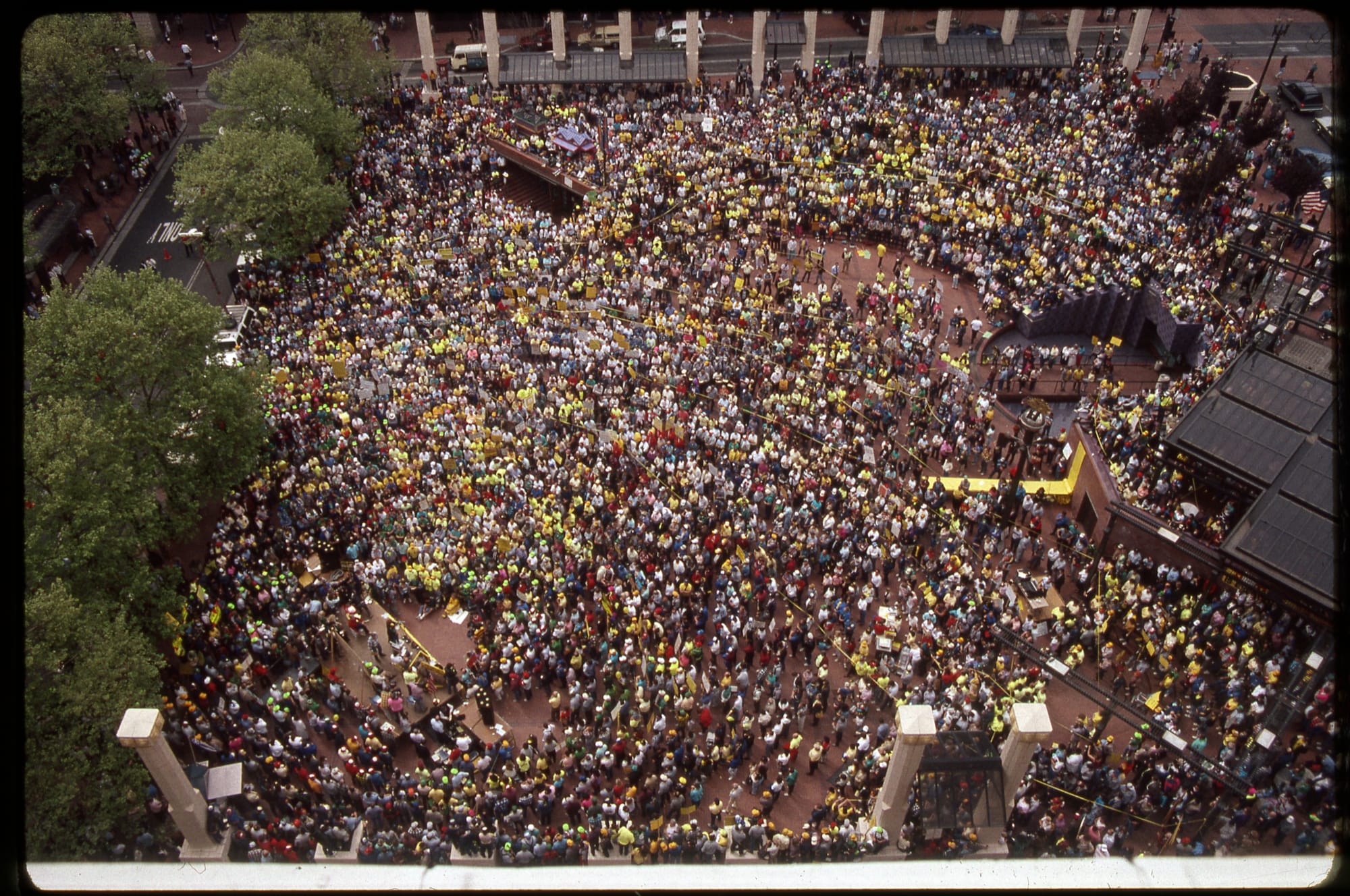
Six million people living in hard-hit rural western timber, farming, and ranching communities have been strumming on their one remaining string since the federal government added the northern spotted owl to the Endangered Species Act’s threatened species list in June 1990.
Nearly 36 years ago...
One string is not much of an instrument, but it is enough to keep time. Enough to carry memory. Enough to remind us that the music has not died.
The audacity to hope is a phrase with a very long pedigree.
Isaiah 41:10, written by the prophet 800 years before Christ’s birth, says:
“So do not fear, for I am with you; do not be dismayed, for I am your God.
I will strengthen you and help you; I will uphold you with my righteous right hand.”
Martin Luther King Jr. said as much while standing on the steps of the Lincoln Memorial on August 28, 1963. It was the culmination of his Jobs and Freedom march on Washington, D.C. Some 250,000 demonstrators marched with him.
His immortal “I Have a Dream” speech galvanized the civil rights movement. Five years later, James Earl Ray shot him dead while he stood on the balcony of the Lorraine Motel in Memphis, Tennessee.
Here is what Reverend King said:
“When we allow freedom to ring, when we let it ring from every city and every hamlet, from every state and every city, we will be able to speed up that day when all of God’s children, Black men and white men, Jews and gentiles, Protestants and Catholics, will be able to join hands and sing the words of the old Negro spiritual, ‘Free at last, free at last, Great God-a-Mighty, we are free at last.’”
Franklin D. Roosevelt, speaking to a nation battered by the Great Depression, offered the same kind of hope in his first inaugural address in 1933:
“This great Nation will endure as it has endured, will revive and will prosper.”
It was not sentimental hope. It was hope spoken into fear, scarcity, and uncertainty.
Then-Senate candidate Barack Obama modified “the audacity to hope” to “the audacity of hope” in his keynote address at the Democratic National Convention in 2004. Two years later, he wrote a bestselling book by the same title. In 2008, following a bruising primary battle against Hillary Clinton, he defeated John McCain, becoming the first Black president in American history.
Speaking after his 2012 re-election, Obama said:
“I have never been more hopeful about America. And I ask you to sustain that hope.”
He was not describing blind optimism. He was describing the kind of hope that survives difficulty because people are willing to work, reach, and fight for something better.
The language of freedom, dignity, and hope does not belong to one party, one president, one preacher, or one movement. It reaches across generations because human beings have always needed it most - especially when the road ahead was hardest to see.
Reverend King said as much.
So have many men and women of faith, public service, and moral leadership.
Hope is universal. It exists and blossoms even in darkness. It does not belong to the messenger. It lives in all of us.
A quick reminder before you continue reading...
Evergreen cannot run on good intentions alone.
Independent forestry journalism takes time, travel, research, interviews, editing, photography, web publishing, and decades of earned trust.
It is work — and like the work you do, it has to be supported.
If Evergreen helps you understand the decisions shaping our forests, communities, and future, please subscribe or contribute today.
Subscribe. Contribute. Help keep Evergreen independent.
Subscribers receive access to many of Evergreen’s back issues in our Archives.
Our archives hold a deep record of forestry reporting, history, policy, people, and practice.
Looking for a specific issue or topic?
Let us know, and we will help you find the Evergreen
coverage you need.
Prefer PayPal?
You can set up an ongoing donation, and we will honor it as a subscription with the same benefits.
Support forest-to-community health. Support Evergreen.
THANK YOU!
We are frequently asked if we are hopeful about the outcome of the Trump Administration’s announced Forest Service realignment, which Forest Chief Tom Schultz has described in numerous interviews and speaking engagements, including his April 7 speech here in Coeur d’Alene.
Yes, we are hopeful.
For the first time in a very long time, the Forest Service is being repositioned closer to the landscapes, communities, and working forests most directly affected by its decisions.
USDA has announced that Forest Service headquarters will move from Washington, D.C., to Salt Lake City, Utah, as part of a broader restructuring that includes a state-based leadership model, Operations Service Centers, and changes to the agency’s research structure.
That matters.
The West is where most of the nation’s public forestland, wildfire risk, working forest communities, and federal land-management conflict now converge. Moving leadership closer to the land will not solve every problem. It will not end litigation. It will not instantly restore trust.
It is a structural acknowledgment of something rural westerners have known for decades: decisions about western forests cannot remain permanently isolated from the people and communities that live with their consequences.
Yes, we are hopeful.
But the road ahead leading to freedom, dignity, and mutual respect is longer than many rural westerners hope - or believe they will live to see.
Litigators representing the interests of anti-forestry groups will fight realignment all the way to the Supreme Court in hopes of silencing rural westerners for good. They know that if they lose, their taxpayer-paid funding model could blow up in their faces.
The audacity to hope thus becomes the price we must pay to defend our right to actively participate in public and congressional debates where the future of the West’s great public forests will be determined. We must not allow anti-forestry activists to silence our voices.
President Ronald Reagan captured the bedrock truth of this fight to the finish in his first inaugural address as California governor in 1967:
“Freedom is never more than one generation away from extinction.”
Your 100% tax-deductible subscription allows us to continue providing science-based forestry information with the goal of ensuring healthy forests forever.