
Defining wildfire economics
What the hell is wildfire economics? The answer runs from firefighting aircraft and litigation to salvage logging, sawmills, replanting, and
What the hell is wildfire economics? The answer runs from firefighting aircraft and litigation to salvage logging, sawmills, replanting, and

Fire ecologist Leda Kobziar on living microbes, public health, and why wildfire smoke must become our responsibility. Coughing and struggling
How Wildland Fire Policy Shifted Danger from Firefighters to Everyone Else - and How the Forest Service Lost the Public Along

Tom Schultz’s mind runs at about a million miles a minute.
I have seen evidence of this several times over the years I have known him. No other Forest Service Chief I have known possessed this ability.
When Schultz keynoted the Public Lands Collaborative Conference on April 7 in Coeur d’Alene, he had 29 pages of notes but rarely looked at them.
At my request, he mailed them to me after he returned to his Washington, D.C., office the following Monday. They contain none of the blizzard of statistics he rattled off in about 50 minutes. I suspect he has a photographic memory.
Schultz’s affinity for statistics that underscore the necessity of realigning the entire U.S. Forest Service is stunning. But he began his keynote address by reminding the nearly 100 forest stakeholders in the room that their efforts were “essential to the health of our forests and the strength of our rural communities.”
“If there is one truth that has guided the Forest Service since its founding, it is partnerships,” he said. “They are key to success.”
It was a theme he repeated several times during his 45-minute speech.
“From my first day as Chief, I have focused on returning to fundamentals,” he said, “keeping people safe, reducing risk to communities, actively managing forests so they remain productive and resilient, and improving recreation access.”
“We will never compromise on safety,” he continued, adding that “wildfire readiness remains central to our mission. Our firefighters are world-renowned for rapid response. This year we are leaning into that strength to keep fires small and communities safe.”
It is a tall order, given the controversy swirling around the Trump Administration’s apparent desire to transfer Forest Service firefighting responsibilities to the newly minted U.S. Wildland Fire Service, which would be housed within the Department of the Interior.
I do not know a single Forest Service retiree who thinks this is a good idea. Nor can I find a retiree who thinks realignment is workable. They say they do not see a chain of command that can link policy, regulations, and boots on the ground.
Others say the realignment Schultz seeks has been compromised by Department of Government Efficiency layoffs that left the agency shorthanded at the very moment when years of experience with the nuts and bolts of realignment are critical to its success.
Meantime, Chief Schultz is living out of a suitcase, traveling three weeks out of four, explaining the realignment process in detail and answering every question from diverse audiences.
In Coeur d’Alene, he described the realignment process — a first in the agency’s 121-year history — as “an exercise in blocking and tackling.”
“Lots of change is underway, and change is hard,” he said. “Many do not like it, but more active forest management is not optional. It is essential. We cannot continue business as usual. It has not been working for our forests and grasslands or for the American people for quite some time. Things must change.”
Schultz is very quotable because he is a “how-to” guy with a laundry list of realignment goals and objectives that he easily recites from memory.
“This is how we will restore health in our forests.”
“We are strengthening rapid response capacity, realigning interagency resources, and investing in year-round preparedness.”
“At the same time, we are increasing the use of tools we know work: prescribed fire, mechanical thinning, and cross-boundary treatments that protect entire landscapes and reduce risk.”
“We have to do these things to enjoy the benefits, including outdoor recreation. Recreation demand in our National Forests is growing at historic levels, placing new pressure on infrastructure that counties and communities help support.”
We began arguing the case for forest restoration 18 months before President George W. Bush signed the Healthy Forests Restoration Act in December 2003.
We have explained time and again that the amenities the public seeks in its National Forests — clean air, clean water, abundant fish and wildlife habitat, and a wealth of year-round outdoor recreation opportunities — can only be achieved through forest restoration and active forest management.
It is a package deal.
There are members of the U.S. House and Senate, Republicans and Democrats alike, who are not sure the realignment Forest Service leadership envisions is a good idea.
Many Forest Service retirees — including two Evergreen Foundation board members — are dismayed by it. They see decades of work and institutional memory being swept aside in mere months.
Meantime, across much of the rural West, the reaction is far more hopeful. Rural Western communities have borne the brunt of policies that have steadily eroded the timber-based economies of sawmilling towns long dependent on adequate supplies of federal logs since the end of World War II.
Until the Trump Administration arrived on the scene, it looked as though the last of the West’s family-owned mills would soon perish. Now there is hope.
There is a swirl of rumor driven by anti-forestry groups determined to preserve the political influence they enjoyed when the Forest Service was based in Washington, D.C. Many are well funded enough to own their own buildings and maintain lobbyists, lawyers, and activists within walking distance of Capitol Hill. Their agenda serves interests far removed from the rural communities and working forests living with the consequences of their actions.
The Forest Service has always seen itself as a public servant, not the representative of special-interest groups or their political minions. It has never been good at defending its actions in public forums but, to its credit, this Forest Service has tackled the rumor mill straightaway.
“We struggle with how to communicate,” Schultz lamented in Coeur d’Alene. “It is very challenging. What is being said about realignment on social media and in many newspapers could not be further from the truth.”
“The Forest Service is moving west because that is where most of its land is located,” Schultz continued. “There were no ulterior motives in picking Salt Lake City as the new headquarters. It was picked because you can go pretty much anywhere else in the West from there. Not true of Boise or Missoula.”
Unfortunately, Salt Lake aligned with false rumors that Schultz picked it because Utah Senator Mike Lee has repeatedly proposed privatizing Forest Service and BLM lands in the West — an idea that was quickly shot down by Montana’s Republican Senators Steve Daines and Tim Sheehy.
Among the media distortions the Schultz-led Forest Service is trying to correct:
Schultz’s Coeur d’Alene presentation included a video highlighting the Forest Service’s 2025 accomplishments. We recommend it for anyone who thinks the agency spent last year twiddling its thumbs.
If last year’s progress is any indication of what lies ahead, Shultz and his team are definitely on the right track. A great deal of boots-on-the-ground wildfire and forest health work got done that was left undone during President Obama’s eight years and President Biden’s four years.
The Forest Service’s Organizational Realignment Fact Sheet and its maps explain the agency’s reorganization in great detail. Please read it so that you understand what the news media will not report because they get their “news” from the anti-forestry groups that fear the Forest Service realignment will destroy their sue-and-settle business model.
Schultz bristles at the suggestion that realignment is strictly his idea.
“This isn’t my vision,” he told collaborators in Coeur d’Alene. “It is our vision. It is our opportunity to improve. We are committed to delivering results on the ground faster and more efficiently.”
“We are becoming a more efficient and responsive agency by removing rules and regulations that are not necessary while ensuring that we are sustainably managing these treasured landscapes,” he declared. “The people closest to the ground often understand the forest best. Our job is to remove barriers, increase accountability, and ensure taxpayer dollars produce visible, timely results.”
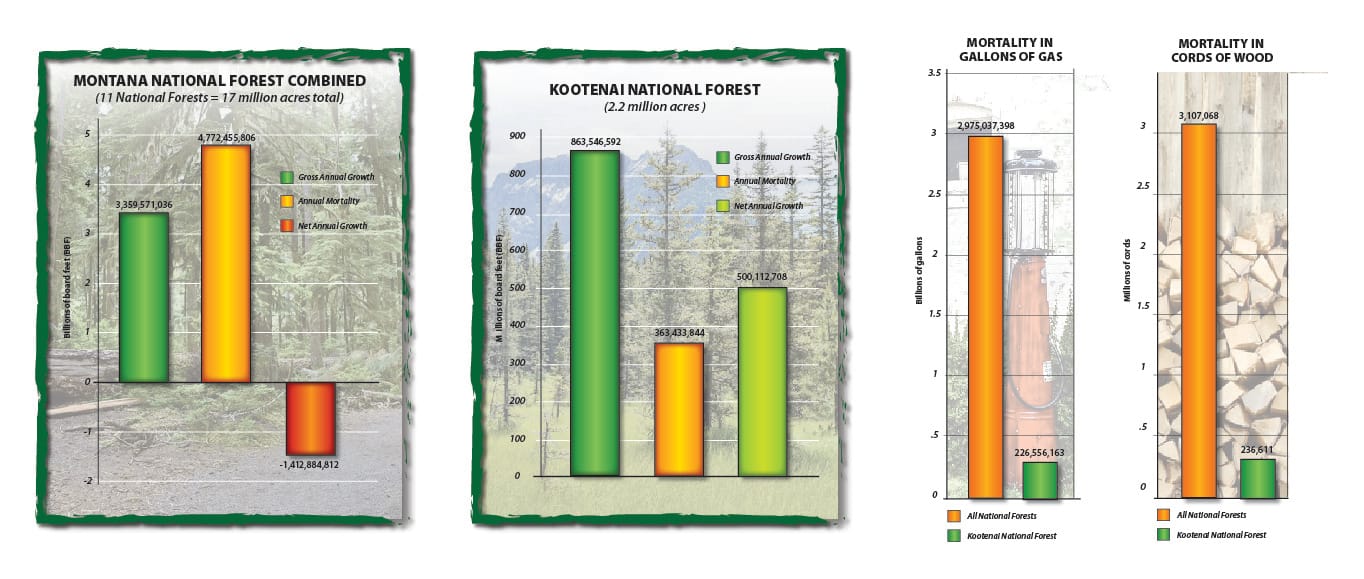
Schultz is fixated on reversing the well-documented fact that forest mortality exceeds growth in all but one of the 12 National Forests in Region 1 — a 25-million-acre expanse that includes every National Forest in Montana and Idaho.
In simple terms, National Forests in the two states are dying faster than they are growing.
A total of 4.8 billion board feet died in the latest reporting year. Net growth — gross growth minus mortality — was negative 1.4 billion board feet. Enough wood to construct about 117,000 three-bedroom homes. Enough to employ more than 1,500 people in logging or milling jobs in Idaho or Montana this year.
They say we need at least 7 reminders to support the work we appreciate - life gets busy.
So here is your reminder...
We use our paywall sparingly - so we rely on your support to continue our work. Your support means we can continue to bring you the quality of content you have come to expect from Evergreen.
If you appreciate our work, Donate or Subscribe.
Much gratitude to those of you who already support our work.
Climate change is not the driving factor...
The major culprit's are bad management, no management, and serial litigation which is aimed at blocking every forest restoration project the Forest Service has proposed in recent years.
“Mortality is awful,” Schultz said. “We are negative in all but one national forest in the Intermountain Region.”
Schultz knows the Intermountain Region well from his years with the Montana Department of Natural Resources and Conservation and, later, the Idaho Department of Lands.
In Montana, he was responsible for six million acres of trust land as well as the Water Resources Division. Perhaps most significantly, he played a key role in development of the Montana Forest Action Plan, a collaboratively developed plan that has become a blueprint for most collaborative stakeholder groups in Montana and Idaho.
As Director of the Idaho Department of Lands, he was responsible for 2.4 million acres of trust timberland managed to meet long-term revenue projections that fund public education and other publicly owned institutions in the state.
He was also responsible for fire protection and prevention on more than six million acres of state, tribal, and privately owned forestlands in Idaho.
Schultz’s fixation on wildfire extends well beyond Idaho and Montana.
“It is the same in California,” he says of the state’s 18 National Forests, a 20.4-million-acre expanse centered in northern California, scene of two recent wildfires that each covered more than one million acres.
“The 235,000-acre Caldor Fire is now considered small by California standards. Where is the public concern about this?” the seemingly flabbergasted Schultz asked his audience.
There is not much concern when you travel beyond rural communities in the 11 western states, despite the fact that the West’s wildfire pandemic now covers more than half of the West’s 193-million-acre federal forest estate.
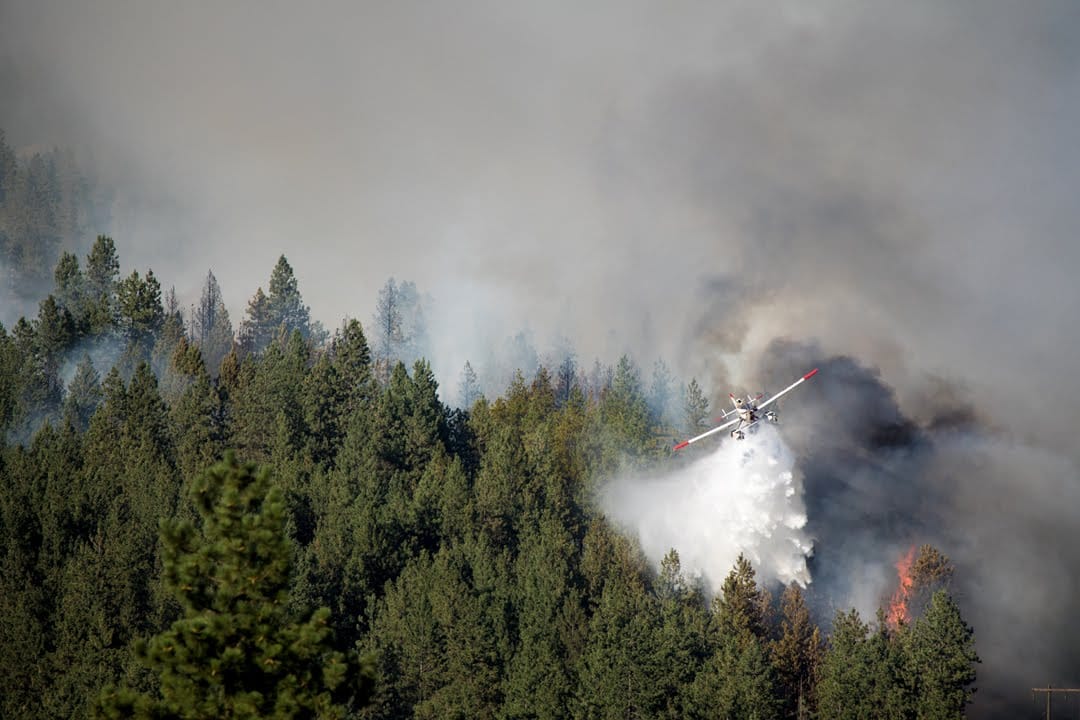
Herein lies the largest piece of the problem Schultz hopes to overcome with a realignment strategy that puts far more emphasis on extinguishing wildfires while they are still small, manageable, and far less expensive to extinguish and replant.
“Timber management — thinning, prescribed burning, and even-aged forest management — are all tools for reducing wildfire risk,” he explained. “If we do not do this, there is no hope for protecting recreation, fish and wildlife habitat, or watersheds that provide clean, cold drinking water for most of the West.”
Before the northern spotted owl was added to the federal government’s threatened species list in 1990, the West’s National Forests and BLM lands routinely harvested between 10 and 12 billion board feet annually — about 25 percent of the nation’s demand for softwood lumber.
“The agency has deployed a National Active Management Strategy that projects a 25 percent increase in harvesting, with a goal to sell four billion feet annually by fiscal year 2028,” Schultz said.
“It is a core part of our back-to-basics approach, refocusing the agency on the fundamental work that matters most to the American people,” he continued. “Active management is not a slogan; it is a workflow. Thinning, prescribed fire, salvage where appropriate, commercial harvesting, and targeted reforestation to reduce risk, recover value, and set forests up for resilience.”
Schultz sees NEPA and future collaboration as keys to success.
“To ensure work is carried out in a timely manner, the Forest Service recently reiterated its commitment to streamlining the National Environmental Policy Act, including a focus on issues-based analysis, prioritizing categorical exclusions, using emergency authorities, relying on existing environmental analyses, and issuing direction on notices, comment periods, and objections.”
None of this will be easy.
Politically powerful preservationist groups led by the Sierra Club insist that no timber ever be harvested from federally owned forests. Wildfires should be allowed to run their course. The environmental impacts of active forest management, they argue, are worse than the impacts of fire.
This is not true, but the claim makes great headlines.
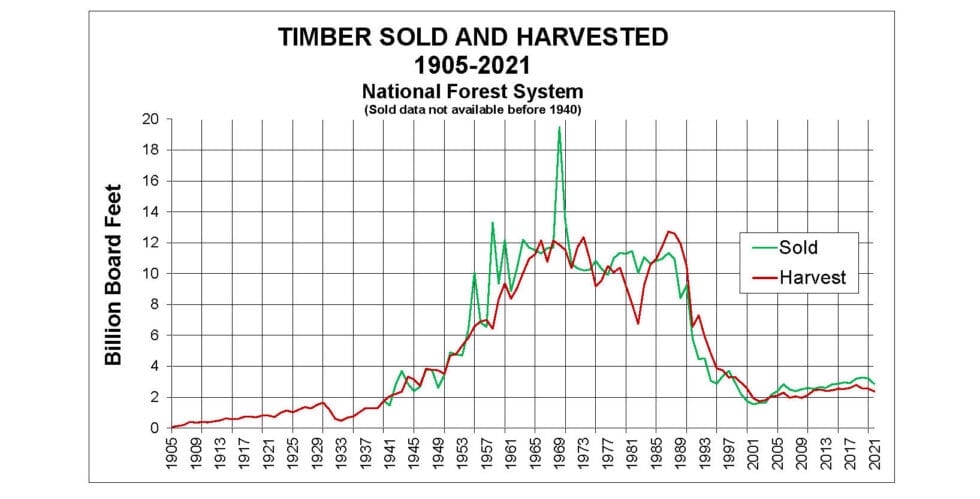
The graph below tracks harvesting from 1905, the year the Forest Service was founded, through 2021. The 2021 harvest was about the same as it was in 1944, and it peaked amid the spotted owl war in 1988.
It slowly collapsed in subsequent years. Litigation and the government’s 1990 decision to add the owl to its threatened species list are the most glaring reasons for the collapse.
Compare the collapse that followed the owl listing to harvest volume between 1905, the year the Forest Service was founded, and 2021, the last year for which data is available. Or compare it to harvest volume during World War II.
Although Schultz did not imply or say it, much depends on Republicans hanging on to their slim majority in the House of Representatives and picking up two or three seats in the U.S. Senate.
If Republicans lose their razor-thin majorities, the Trump Administration will have a difficult time completing its federal forestry agenda, and the West could easily lapse back into another litigation-led, no-management era.
The Forest Service has itself to blame for some of this.
According to Schultz, the agency adheres to 3,400 directives spanning thousands of pages that it heaped on itself through a succession of presidential administrations.
By contrast, the 1905 Use Book, written by Gifford Pinchot, first Chief of the Forest Service, was a pocket-sized 142-page manual carried by Forest Rangers who rode “the high lonesome,” helping settlers get started and looking for timber thieves.
They also relied on the 1899 U.S. Geological Survey, which included an inventory of tree volumes and species best used for different purposes.
“Why do you suppose we have so many rules and regulations we must follow now?” Schultz rhetorically asked his audience. “It is because we have a serious trust issue to overcome. Very few people trust us to follow environmental laws or do what we say we will do. We have to overcome this, and the only way to do it is to realign ourselves in a more transparent way.”
Litigation is one of the more insidious results of the loss of trust Schultz cites. But there has also been a loss of public trust driven by social media doomsayers.
Loss of trust is also the primary reason so little investment capital is flowing into companies that harvest and process federal timber. Mills in Idaho and Montana continue to struggle because they were swept away in the litigation tsunami that followed the 1990 spotted owl listing.
Private capital is flowing to mills that harvest state or private timber, especially in western Oregon and Washington.
Freres Engineered Wood, the world’s leading manufacturer of mass plywood panels, has invested hundreds of millions of dollars in automated systems that yield 4x8x40-foot billets that computer numerical control machines can cut into everything from widgets to the structural members of 25-story buildings.
There are AI-generated conceptual designs for 70-story buildings on the internet.

“More infrastructure is key to the success of our realignment,” Schultz concluded in his keynote address in Coeur d’Alene. “Without private investments in light-on-the-land logging systems, advanced wood processing technologies that can handle smaller-diameter logs, we cannot do anything that significantly benefits the public’s forests or outdoor recreation.”
Schultz took a similar tack in a recent interview with Kevin Lind, a writer with Salt Lake City’s Deseret News.
“This is about common sense. It is about smarter government. It is government where the people are at.
“It is about saving money, being more efficient, getting more work done, partnering with states, tribes, and local governments, and being prepared for the upcoming wildfire season.”
Amen.

Wildfire season is upon us - the “us” being the Southeast and the entire West. The heat is on - literally and

Wildfire has become the magnet among those who share our concern for the damage stand-replacing fires have done on

Public understanding doesn’t grow on its own. Evergreen grows it. For 40 years, we’ve been the independent voice


We recently refined our subscriber list to focus on readers who genuinely engage with Evergreen’s work. If you’re
Your 100% tax-deductible subscription allows us to continue providing science-based forestry information with the goal of ensuring healthy forests forever.