
Keep Our Forests Green!
Rob DeHarpport makes the case for a clear, honest national campaign showing Americans what catastrophic wildfire is costing our forests,
Rob DeHarpport makes the case for a clear, honest national campaign showing Americans what catastrophic wildfire is costing our forests,

What the hell is wildfire economics? The answer runs from firefighting aircraft and litigation to salvage logging, sawmills, replanting, and
Fire ecologist Leda Kobziar on living microbes, public health, and why wildfire smoke must become our responsibility. Coughing and struggling

Frank Carroll is an old friend and a boat rocker of legendary proportion.
He is Vice President of the National Wildfire Alliance and President of Wildfire Pros, a Pueblo, Colorado forest and rangeland consulting firm with a résumé far too long to describe here. Their work is extensive and impressive.
The National Wildfire Alliance was originally formed as the National Wildfire Institute by the late Bruce Courtright, whom we also knew well. Bruce’s long career with the U.S. Forest Service included time with State and Private Forestry and many years as Chief of Management Improvement. As NWI’s founder and board chairman, he was a strong proponent of increased staffing, wildfire prevention, and active forest management.
Frank, along with several others we know – including Evergreen board member Phil Aune – has helped breathe new life into Bruce’s vision with the help of Bob Zybach, another old friend whose essays have appeared on our website dozens of times. No one knows more about the history of tribal cultural influences in western Oregon’s Willamette Valley than Bob. He – and Frank – have been instrumental in connecting many dots at NWA and Evergreen.
Frank’s op-ed goes straight at one of the most protected assumptions in today’s federal wildfire policy: that allowing some wildfires to burn under the banner of “managed fire” is a sound restoration strategy.
Based on his decades of field experience, Frank argues that this policy is outdated, dangerous, and undermines resilience. He believes unplanned wildfires should be suppressed quickly, that post-fire salvage and rehabilitation should begin immediately, and that active forest management – including roads, timber utilization, biomass markets, and restoration funding – must replace the cycle of watching forests burn while ignoring, or worse, blocking active restoration.
Frank is challenging the language, policy, and institutional habits that have shaped wildfire management for decades. You do not have to agree with Frank on every point to understand that in the West – where much of America’s forest wealth is found – something has to change. The West is living with the failure of managed fire policy.
What follows is Frank’s boat rocker: an op-ed he recently wrote for the National Wildfire Alliance.
Minor edits have been made for spelling, grammar, punctuation, and flow.
The devastating wildfires that now characterize the Western landscape do not simply represent a natural disaster. They are the consequence of decades of flawed and politically engineered federal policy. The catastrophic damage wrought by these fires – including the wholesale destruction of wildlife, habitat, and infrastructure – is compounded by a profound crisis in post-fire land management.
To secure the future of our national forests and protect communities in the wildland-urban interface, we must immediately abandon the failed ideology of “managed fire” and implement a strategy of swift suppression followed by aggressive, responsible forest restoration.
The current doctrine of “let burn” or “managed wildfire,” pursued by agencies like the U.S. Forest Service, is a systematic failure. This policy operates under the pretense of “resource management objectives” or “restoration wildfire,” a euphemism that often results in the intentional expansion and ignition of fires, sometimes accounting for a third to a half of the total burned acreage.
As a result, funds appropriated by Congress for emergency suppression are often misspent on prolonged, managed burns for public land management. The conditions on our lands are simply no longer conducive to this strategy. To watch a fire burn is to ignore that the longer a fire burns, the more deadly smoke it produces, contributing to tens of thousands of smoke-related deaths annually.
The first, non-negotiable step to sanity is to declare that all unplanned wildfires will be promptly and aggressively extinguished – a return to the foundational “10 AM Policy” of immediate suppression.
Once the fire is out, the work of true restoration must begin with uncompromising speed. Every passing day after containment results in greater degradation of valuable timber resources and lost economic opportunity. Expedited salvage operations are an essential first step, not merely to preserve timber value, but to generate revenue that can offset the massive costs of firefighting and fund necessary ecological and community rehabilitation.
Crucially, this post-fire effort must focus on the immediate removal of the vast accumulation of hazardous fuels – a condition created by the very lack of management and “let burn” tactics we criticize. It is a stark paradox that we currently observe millions of board feet of prime timber being burned in house-sized piles instead of being utilized for restoration funding.
This brings us to the core of the long-term solution: Active Forest Management that focuses on Care, Utilization, and Protection – CUP.
First, we must reclaim the term “forest restoration” itself. When used by the Forest Service, “restoration” often means aggressive and excessive cutting and frequent burning that removes significant portions of the forest and leaves the land in a perpetually degraded state. True restoration, however, must be built on a foundation of historical understanding, using multidisciplinary research to determine the pre-1850 landscape condition we are aiming to restore.
Second, genuine Active Forest Management requires the wholesale removal of hazardous fuel buildups and extensive, aggressive forest management, including a significant annual timber harvest, to return our national forests to a healthy and productive condition.
Evergreen cannot run on good intentions alone.
Independent forestry journalism takes time, travel, research, interviews, editing, photography, web publishing, and decades of earned trust.
It is work — and like the work you do, it has to be supported.
If Evergreen helps you understand the decisions shaping our forests, communities, and future, please subscribe or contribute today.
Subscribers receive access to many of Evergreen’s back issues in our Archives.
Our archives hold a deep record of forestry reporting, history, policy, people, and practice.
Looking for a specific issue or topic?
Let us know, and we will help you find the Evergreen
coverage you need.
Prefer PayPal?
You can set up an ongoing donation, and we will honor it as a subscription with the same benefits.
Support forest-to-community health. Support Evergreen.
THANK YOU!
Finally, the restoration effort must include rebuilding vital infrastructure. This means restoring and maintaining forest roads that are critical for rapid emergency response, fire suppression, and sustainable resource management. The current failure to maintain these access points has been a predictable and preventable factor in fire spread.
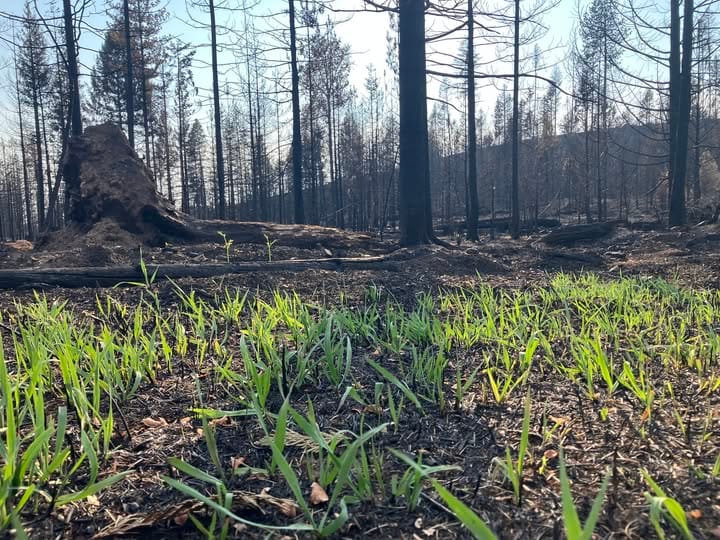
Post-fire site rehabilitation is also essential, including the clean-up of dead vegetation, restoring soils lost to flooding, and replanting to fight invasive weed blooms that inevitably follow a fire.
This level of change requires a massive commitment of resources – estimated at an additional $2.2 to $3.7 billion annually for the national forests alone over the next five to seven years. It requires administration and Congressional direction through executive order and legislation to support the solution.
We cannot afford to continue with a policy that negligently destroys private property, leads to massive smoke-related mortality, and leaves our forests in an increasingly unstable state.
The path forward is a cohesive strategy that prioritizes immediate suppression, rapid salvage, the economic utilization of biomass, and science-based active management to restore our public lands to safer, more profitable, and more accessible conditions.
We must demand full transparency and accountability from federal agencies and insist they fulfill their non-discretionary duty to protect the land and serve the people.
Frank Carroll is an old friend and a boat rocker of legendary proportion.
He is Vice President of the National Wildfire Alliance [NWA] and President of Wildfire Pros, a Pueblo, Colorado forest and rangeland consulting firm with a resume far too long to describe here. Here's the link to their very impressive website. https://www.wildfirepros.com/
NWA was formed as the National Wildfire Institute by the late Bruce Courtright, who we also knew well. Bruce's long career with the U.S. Forest Service included stints with State and Private Forestry and many years as Chief of Management Improvement. As NWI's founder and board chairman, he was a proponent of increased staffing, wildfire prevention and active forest management.
Frank and several others we know, including Evergreen board member Phil Aune, breathed new life into Bruce's vision with the help of Bob Zybach, an old friend whose essays have appeared on our website dozens of times. No one knows more about the history of tribal cultural influences in western Oregon's Willamette Valley than Bob. He - and Frank - have been instrumental in connecting many dots at NWA and Evergreen.
Here's Frank's boat rocker - an op-ed he wrote recently for NWA.
The devastating wildfires that now characterize the Western landscape do not simply represent a natural disaster; they are the consequence of decades of flawed and politically engineered federal policy. The catastrophic damage wrought by these fires, which includes the wholesale destruction of wildlife, habitat, and infrastructure, is compounded by a profound crisis in post-fire land management.
To secure the future of our national forests and protect communities in the wildland-urban interface (WUI), we must immediately abandon the failed ideology of "managed fire" and implement a strategy of swift suppression followed by aggressive, responsible forest restoration.
The current doctrine of "let burn" or "managed wildfire," pursued by agencies like the U.S. Forest Service (USFS), is a systematic failure. This policy operates under the pretense of "resource management objectives" or "restoration wildfire," a euphemism that often results in the intentional expansion and ignition of fires, sometimes accounting for a third to a half of the total burned acreage.
As a result, funds appropriated by Congress for emergency suppression are often misspent on prolonged, managed burns for public land management. The conditions on our lands are simply no longer conducive to this strategy; to watch a fire burn is to ignore that the longer a fire burns, the more deadly smoke it produces, contributing to tens of thousands of smoke-related deaths annually. The first, non-negotiable step to sanity is to declare that all unplanned wildfires will be promptly and aggressively extinguished—a return to the foundational "10 AM Policy" of immediate suppression.
Once the fire is out, the work of true restoration must begin with uncompromising speed. Every passing day after containment results in greater degradation of valuable timber resources and lost economic opportunity. Expedited salvage operations are an essential first step, not merely to preserve timber value but to generate revenue that can offset the massive costs of firefighting and fund necessary ecological and community rehabilitation.
Crucially, this post-fire effort must focus on the immediate removal of the vast accumulation of hazardous fuels—a condition created by the very lack of management and "let burn" tactics we criticize. It is a stark paradox that we currently observe millions of board feet of prime timber being burned in house-sized piles, instead of being utilized for restoration funding.
This brings us to the core of the long-term solution: Active Forest Management that focuses on Care, Utilization, and Protection (CUP).
First, we must reclaim the term "forest restoration" itself. When used by the Forest Service, "restoration" often means aggressive and excessive cutting and frequent burning that removes significant portions of the forest and leaves the land in a perpetually degraded state. True restoration, however, must be built on a foundation of historical understanding, using multidisciplinary research to determine the pre-1850 landscape condition we are aiming to restore.
Second, genuine Active Forest Management requires the wholesale removal of hazardous fuel buildups and extensive, aggressive forest management, including a significant annual timber harvest, to return our National Forests to a healthy and productive condition. We must embrace the "Utilization" component of stewardship, expanding the beneficial use of biomass and residual forest products—such as through innovative, wood-based nanotechnology—to create high-value markets for low-value wood. This economic engine is critical for financing the necessary pace and scale of restoration across millions of acres annually.
Finally, the restoration effort must include rebuilding vital infrastructure. This means restoring and maintaining forest roads that are critical for rapid emergency response, fire suppression, and sustainable resource management. The current failure to maintain these access points has been a predictable and preventable factor in fire spread. Post-fire site rehabilitation is also essential, including the clean-up of dead vegetation, restoring soils lost to flooding, and replanting to fight invasive weed blooms that inevitably follow a fire.
This level of change requires a massive commitment of resources—estimated at an additional $2.2 to $3.7 billion annually for the National Forests alone over the next 5-7 years. It requires Administration and Congressional direction via Executive Order and legislation to support the "solution".
We cannot afford to continue with a policy that negligently destroys private property, leads to massive smoke-related mortality, and leaves our forests in an increasingly unstable state.
The path forward is a cohesive strategy that prioritizes immediate suppression, rapid salvage, the economic utilization of biomass, and science-based, active management to restore our public lands to safer, more profitable, and more accessible conditions. We must demand full transparency and accountability from the federal agencies and insist they fulfill their non-discretionary duty to protect the land and serve the people.
Your 100% tax-deductible subscription allows us to continue providing science-based forestry information with the goal of ensuring healthy forests forever.