
You read everything...we should talk.
You, loyal reader, open every Evergreen post - 100% of the time (we love that) - for free (we would
You, loyal reader, open every Evergreen post - 100% of the time (we love that) - for free (we would

Before you read our latest article, join the 100 readers who support Evergreen. If you’re reading this, you’re

From Wild Bill Hagenstein to the Big Bang, a reflection on curiosity, science, and belief. A Question from a Reader.

From Wild Bill Hagenstein to the Big Bang, a reflection on curiosity, science, and belief.
I am constantly amazed by the questions I am asked by people who read our essays. The latest question came in reply to our February 25 essay about the life and times of the late Bill Hagenstein.
“Are you a Christian?” our reader asked.
More on this question in a moment... first, a refresher on Wild Bill.
Bill was a legend in the forestry world. He was the only Executive Director the Industrial Forestry Association ever had. During his IFA years—1949 to 1984—he testified before U.S. House and Senate committees and subcommittees more than 250 times.
I know this because I have copies of every speech he gave, every article he wrote, and the transcripts from several hearings that he thought were vital to the interests of IFA’s members: clearcutting, log exports, the 1953 Morse Amendment to the Small Business Administration Act, and the rancorous 1955 Chudoff-Neuberger hearings. Bill said the transcript read “like a goddamned dime novel.”
I first interviewed Bill in 1972 as part of a clearcutting series I assembled for the Grants Pass Daily Courier. A friendship soon developed, and we remained friends for 43 years. He was a walking encyclopedia where federal forest policy was concerned. His home library was voluminous.
Five years before his death in 2014, I asked Bill how he wanted to be remembered. Without hesitation he said, “I was just a worker in the vineyard. That’s all. Just a worker in the vineyard.”
Bill had a well-earned reputation for his candor, but his reference to being a worker in the vineyard surprised me. He was referring to Christ’s parable in Matthew 20:16.
Jesus used parables to teach moral or spiritual truths. In Matthew 20:16 he tells the story of a landowner who hires workers for his vineyard at various times of the day. He pays all of them the same wage. Hence the parable: the last will be first and the first will be last, reversing our earthly standards for status and success.
Similar parables appear many times in the Bible. Did Bill know this? Was he a Bible reader? Did he even own a Bible?
I have no idea, but his describing himself as a worker in the vineyard conjured up a hilarious image of the swear jar Bill Greeley put on the front counter at the West Coast Lumbermen’s Association office in Seattle after he hired Bill.
Many who spoke at Bill’s 2014 memorial service also swore in their remarks as a measure of respect for his years of service to the nation’s forest products industry.
I explained my interpretation of Matthew 20:16 to the website reader who wrote me after we posted Bill Hagenstein’s Prediction. His question startled me as much as I suspect Bill was startled by me asking him how he wanted to be remembered.
Hopefully this essay will answer his question.
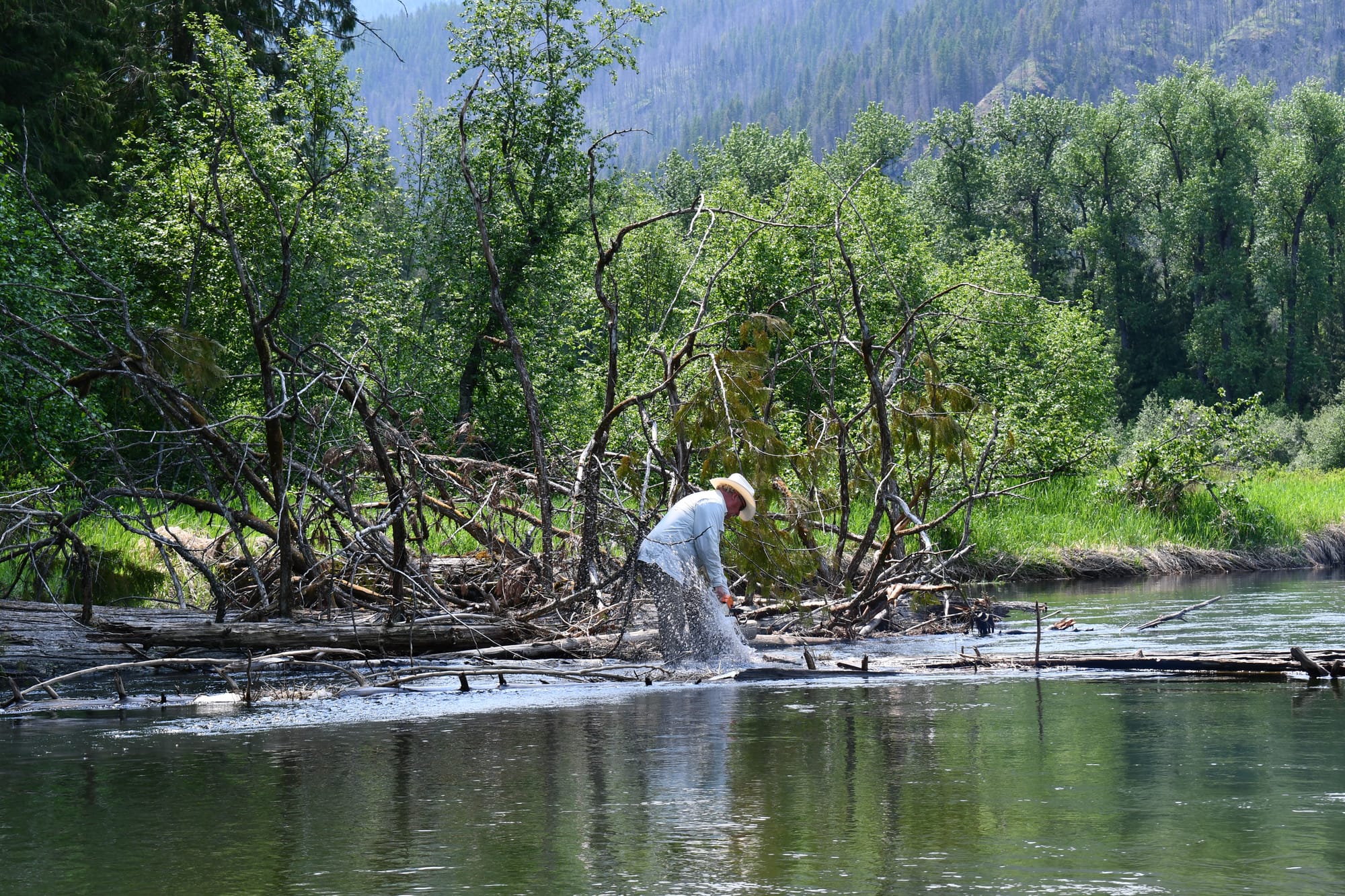
I’ve always held my religious beliefs very close. Julia and I are regular churchgoers, but I generally experience more peace in a day of flyfishing in Montana than I do in attending Sunday services at our Methodist church here in Coeur d’Alene.
I learn a great deal from our pastor’s sermons because she’s an intellectual. Her undergraduate degree is in political economics, so she has a solid understanding of what’s happening in the world today. I respect her and enjoy her sermons.
I view this website and Evergreen Magazine as tools for exercising my God-given writing ability and for pursuing my curiosity about the seemingly unanswerable questions that clutter forestry’s many scientific disciplines.
Does my dedication to my craft make me a Christian? I’d like to think so, but I often fail the parable test. Thankfully, just last Sunday our pastor told us that she believes God blesses the curious.
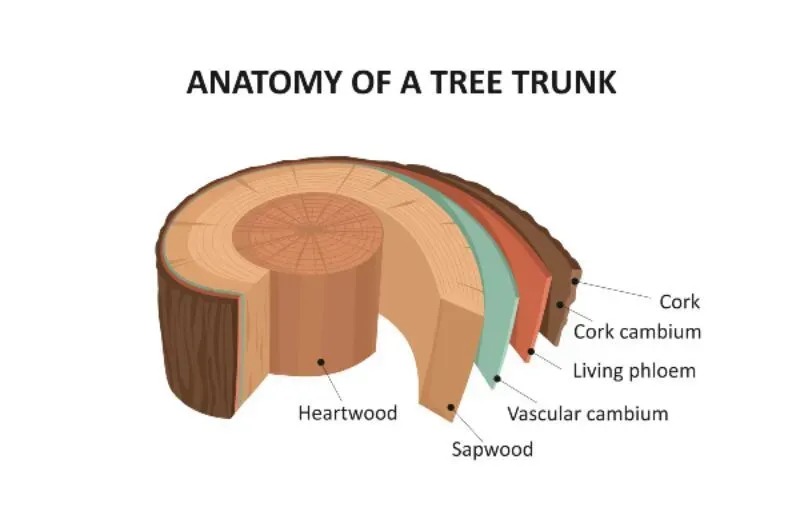
I hope she’s right because I am very curious about a few things in the forestry world that are unexplainable: photosynthesis, carbon storage, and the way tree rings are laid up in six layers—heartwood, sapwood, vascular cambium, living phloem, cork cambium, and cork.
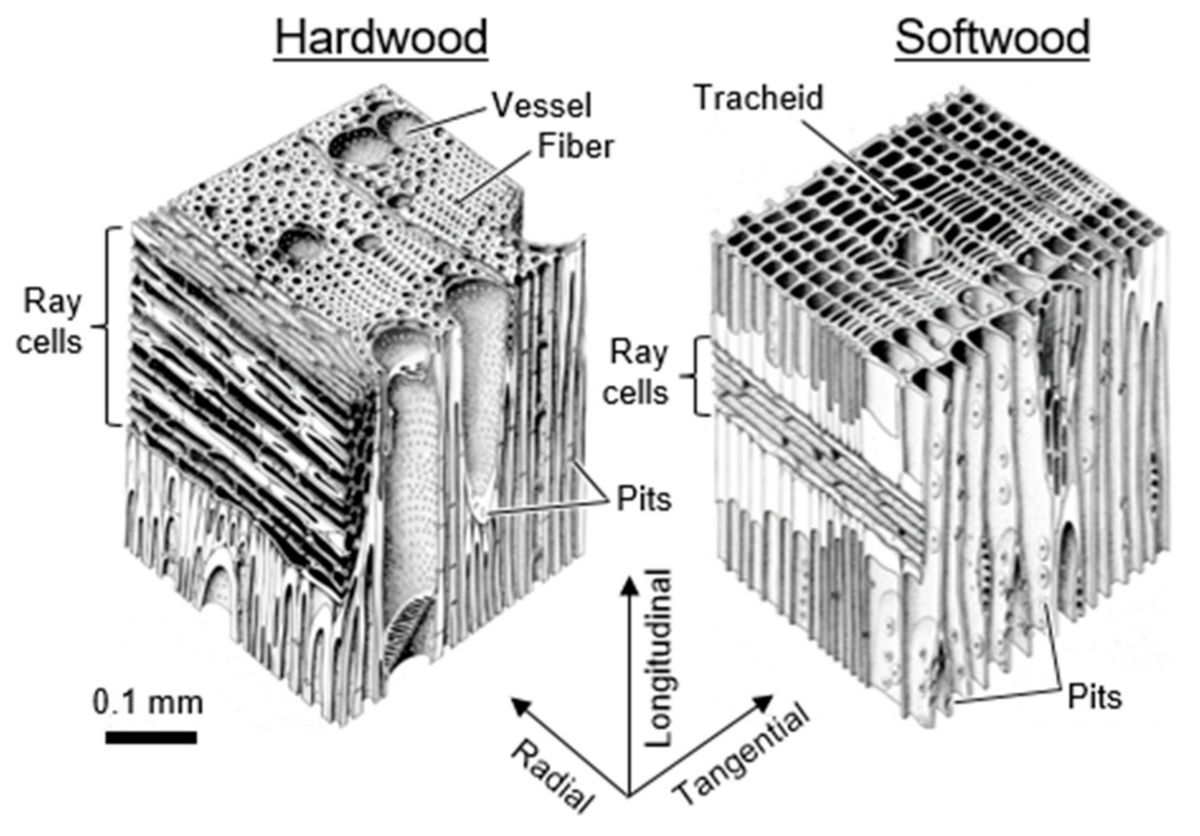
Under a microscope you can easily see why wood is so incredibly strong: long, hollow cellulose fibers bundled like straws and bound together by lignin, a complex renewable polymer found in plant cell walls.
The illustration below shows why wood has incredible compression and tension strength. It was drawn by my late friend Bruce Hoadley, Professor Emeritus of Wood Science and Technology at the University of Massachusetts, Amherst.
The growth process in all plants is called photosynthesis. It is powered by the free, non-polluting energy of the sun. This process begins with seed germination.
Here’s the equation for photosynthesis:
6CO₂ + 6H₂O → C₆H₁₂O₆ + 6O₂
What we don’t know is how nature’s mixing bowl works. How exactly do trees absorb and sequester carbon dioxide while releasing oxygen into the air we breathe?
What’s often lost in the climate change conversation is that carbon is one of Earth’s essential building blocks.
No carbon. No trees.
But what invisible force makes wood the only renewable, recyclable, and biodegradable building material on Earth? And what makes it more energy efficient in its manufacture and use than any competing building material?
Gifford Pinchot, first Chief of the U.S. Forest Service, took a circumspect approach to this question in Breaking New Ground, his autobiography, published in 1947 by Harcourt, Brace and Company.
Without natural resources life itself would be impossible, Pinchot wrote. From birth to death, natural resources, transformed for human use, feed, clothe, shelter, and transport us. Upon them we depend for every material necessity, comfort, convenience, and protection in our lives. Without abundant resources prosperity is out of reach.
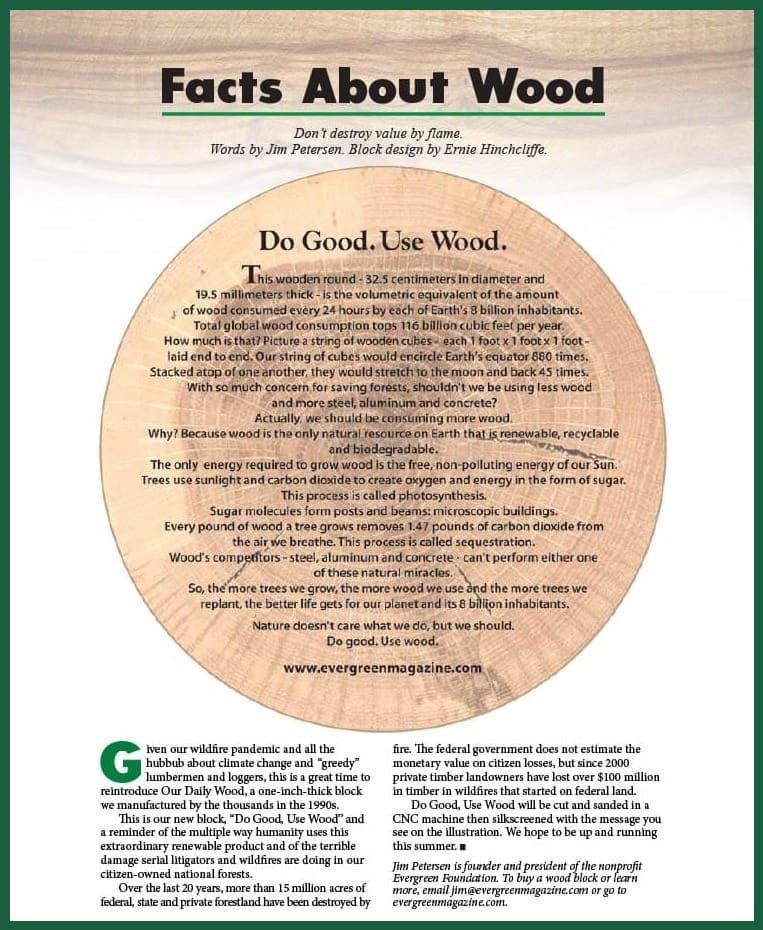
In the Daily Wood illustration below we add poetry to Pinchot’s point about nations transforming natural resources for human use:
Do Good. Use Wood.
Here is possibly the biggest unanswerable question about photosynthesis.
Does the equation replicate the Big Bang theory favored by most planetary scientists? It should, because photosynthesis and the Big Bang both involve light—a lot of it.
But what triggered the Big Bang—and what invisible forces energize photosynthesis? We don’t know.
We have the equation for photosynthesis and we know that it takes the sun’s visible, infrared, and ultraviolet light energy eight minutes and twenty seconds to reach Earth.
But what force triggered the Big Bang? And what force triggers photosynthesis? No one knows, so we are asked to “trust the science.”
I do trust peer-reviewed science, but the Big Bang wasn’t peer-reviewed before it occurred, so we have no idea what set it off.
If you ask a planetary scientist what triggered the Big Bang you’re likely to see shrugged shoulders. Or they’ll cite Intelligent Design, a pseudo-scientific argument that tiptoes up to the existence of God and the origins of life on Earth.
But the late theoretical physicist Stephen Hawking argued against Intelligent Design. He hypothesized that the universe created itself from nothing—and that the nothingness initiated its own Big Bang.
He assumes endless time functioned like a dimension in space, meaning there was no before, so no Creator was needed.
Hawking also hypothesized that the universe will end when all of the stars run out of energy. Scientists associated with the James Webb Telescope estimate there are 1,000 quintillion (10³⁶) stars in the observable universe. Clearly, the light that accompanied the Big Bang and powers photosynthesis will be with us for billions of years.
We are left with Paul’s New Testament instruction concerning the mystery of faith.
The faith part loops back to Genesis, the first chapter in the Bible. Traditionalists believe it was written by Moses during the 40 years he wandered in the desert, but modern biblical scholars believe it was compiled from several sources between the fifth and fourth centuries before Christ.
Genesis begins with 45 words that describe the Big Bang theory in about the same way that most planetary scientists describe it—minus all the scribbling that is only understood by other planetary scientists.
In the beginning God created the heavens and the earth. The earth was formless and empty, darkness was over the surface of the deep, and the Spirit of God was hovering over the waters. And God said, “Let there be light,” and there was light.
Atheists do not accept the idea advanced by these 45 words. Christians don’t question it, and many people in other faith traditions believe the universe was created by a higher power.
I accept this. But I remain very curious about how all of this could happen out of nothing but darkness.
Science can’t answer this question. Hawking tried, but he could not find a beginning point for our universe, so he solved his unsolvable problem by saying that there was no beginning point—but there will be an ending -Nah.
For some crazy reason all of this reminds me of a photograph I took in the early 90s—a loaded Kenworth log truck idling at a stoplight on Highway 2 just west of Kalispell, Montana not long after the federal timber supply began its slow-motion collapse in the wake of the 1990 spotted owl listing.
The driver was Alan Beaulieu. We met in Libby in 1980 but I no longer remember the circumstances.
There were hundreds of Kenworths hauling logs in northwest Montana in the 1980s, but Alan’s was easily spotted because he’d hand-painted Going on Faith — John 3:16 on the air cleaner and engine hood cowling.
For God so loved the world that he gave his one and only Son, that whoever believes in Him shall not perish but have eternal life.
I think John 3:16 offers hope and reassurance for the weary and the downtrodden in a world filled with unanswerable questions, including the ones that even peer-reviewed science cannot explain.
Apart from our chance reunion at an intersection in Kalispell, I never saw Alan again. He went on to his final reward in February 2020.
I’m certain Alan and Bill Hagenstein have found much to talk about concerning the vineyard in which they both toiled for decades.
They were both loggers at heart.
Unanswerable questions will always linger.
I think this is why—no matter our chosen religion—most of us spend much of our lives going on faith.
Evergreen Magazine is an independent voice for forestry and forest communities. If you value thoughtful reporting, interviews, and essays like this one, please consider supporting the Evergreen Foundation.
Your support helps us continue telling the stories of the people, forests, and communities that shape the future of forestry.
Your 100% tax-deductible subscription allows us to continue providing science-based forestry information with the goal of ensuring healthy forests forever.