
The Pack-A-Day Club, Reconsidered
Editor's Note: This article was first drafted in October 2017 and published in January 2018. Here we are
Editor's Note: This article was first drafted in October 2017 and published in January 2018. Here we are


"Constant procedural tinkering does not, I fear, lead to efficiency or simplicity." Long before the recently announced Forest
You, dear reader, are reading our Evergreen posts - (we love that) - for free (we would like to change

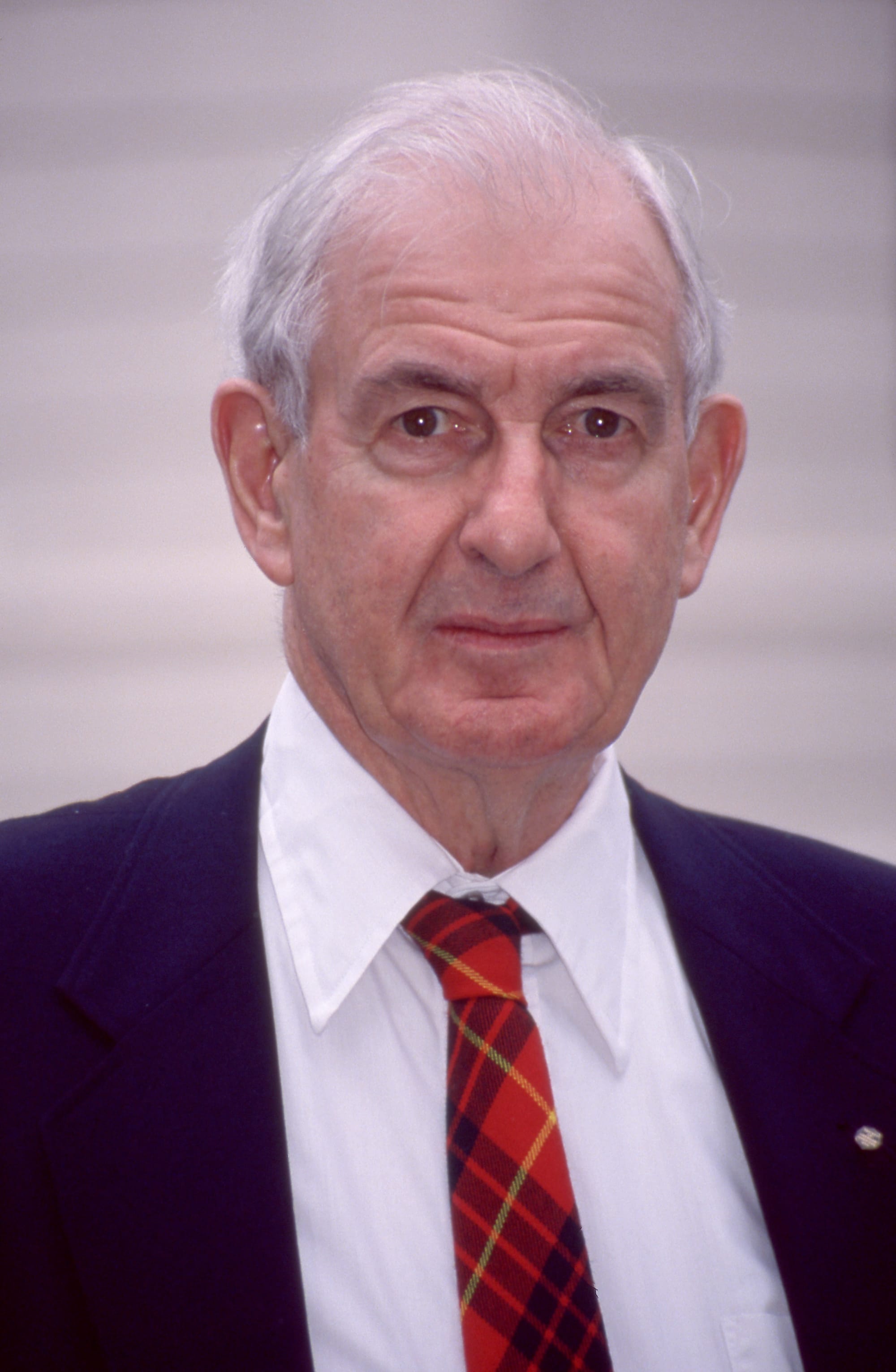
Bill Hagenstein and I were friends for 43 years. He inspired my early interest in forestry. I first interviewed him in his office in the old Neighbors of Woodcraft Building in uptown Portland in April 1972.
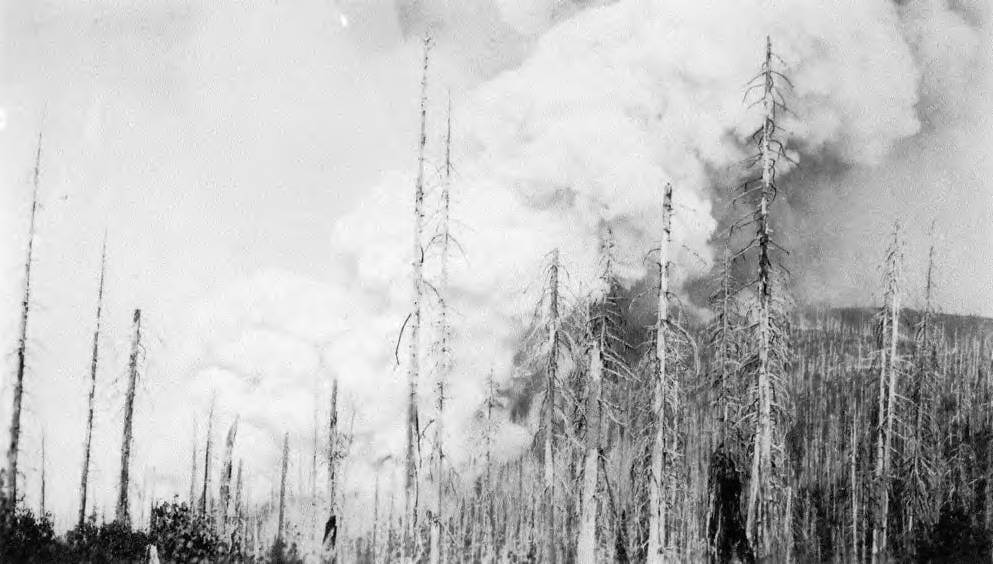
He was the only Executive Director that the long gone Industrial Forestry Association ever had. In his wild and crazy youth he had managed a fire crew on the 1934 Pete King Fire. It leveled between 60,000 and 250,000 acres in Idaho’s Nez Perce-Clearwater National Forest. No one knew for sure because the Selway-Lochsa River drainages were then largely roadless.
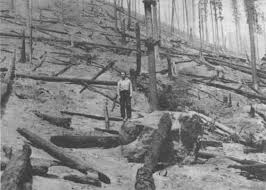
Hagenstein, who was then 19 years old, led his crew as close to the inferno as they could get. They worked day and night to gain some semblance of control and didn’t bathe for more than two weeks. Like duck down, ash filled their eyes and nostrils. Hornets were everywhere. Bill stuck a burning torch in a hive, killing all but the ones that flew up his pant legs.
Years later, in one of our many interviews, Bill told me that he deeply regretted hopping a freight train to Idaho without telling his mother where he was going. He was determined to help her make ends meet after his father died when he was 12.
Bill was already six feet tall when he was 12, so he had no trouble passing for 18 – the legal hiring age for a job as a whistle punk, one of the most dangerous jobs in the woods. He moved from logging camp to logging camp in railroad boxcars.
By happenstance, he was in the Great Northern railroad yard in Spokane when the Forest Service set up a hiring office next to the tracks. He was soon on his way to Lowell, Idaho – the jumping off point for crews battling the Pete King Fire.
Now 19, he was a muscular six-feet-four. He wore the same woods garb he’d worn since he was 12, right down to his calked boots. He cussed a blue streak – even in casual conversation – but there was a presence about him that caught the eye of the Pete King Fire hiring officer.
“You’ll make a great crew boss,” he told Bill before he left the railyard bound for Lowell, Idaho where he would pick up his 50-man crew and make the 15-mile walk to their fire camp. Each man – Bill included – lugged at least 60 pounds of tools more than 10 miles.
He made enough money on the Pete King Fire to pay for his first year in forestry school at the University of Washington.
Metaphorically, no one in the forest products industry fought more wildfires than Bill fought during his lifetime. During his subsequent IFA years – 1949 to 1984 - he testified before U.S House and Senate Committees and Subcommittees more than 250 times. I know this because I have copies of every speech he gave and every article he wrote.
Bill was polite, prolific and professional in a way no forest industry executive will ever match. Not surprising given that he was trained by Bill Greeley, a pious New Englander and the third and arguably best Chief the Forest Service ever had.
After eight years in the Washington office, Greeley abruptly resigned in 1928 to take a job as Secretary-Manager of the struggling West Coast Lumbermen’s Association in Seattle.
In 1941, Greeley hired Bill to be his Western Washington Forester, a job for which he was eminently qualified given his voluminous persona - well honed during his 14 years in logging and fire camps.
Bill's booming voice and his penchant for swearing in the office so frustrated the pious Greeley that he placed a swear jar on the office counter. Every time Bill swore Greeley insisted that he put a nickel in the jar.
When someone asked one afternoon where Bill had gone, Greeley laconically replied, “Bill’s gone out for another bushel basket of ‘god dammits.’”
Over his IFA years, Bill became a very prolific writer – especially for a forester who rarely stepped into a forest. There was an almost poetic cadence about his phrasing. Some phrases became his recognizable trademarks, none more so than this: “Wood is the only renewable building, packaging and communications material in the world.”
He was extremely proud of the enormous contributions forestry, logging and wood processing continue to make to our nation’s progress and promise.
Evergreen is committed to preserving and sharing the lived history of forestry and land stewardship in America.
If you value science-based, experience-informed perspectives on how our forests are managed — and how that management shapes our communities — please consider becoming a subscriber or making a tax-deductible donation to support our work.
Subscribe to Evergreen Magazine
Donate to the Evergreen Foundation
If Bill had the proverbial shining hour in his career it was Monday, October 15, 1962. On the previous Friday, the 145 mile-an-hour Columbus Day storm slammed into the Oregon coast. Property damage topped $230 million and at least 46 people were killed.
By Saturday morning, Bill was laser focused on the 11 billion board feet of standing timber that the wind – the strongest in Oregon history - had toppled in just five hours. The volume was equal to the annual harvest for two years in western Oregon and Washington.
By Monday, Bill had marshalled an army of lumbermen, foresters, loggers in his office. They would immediately begin salvage logging downed timber west of the Cascades – a task that would be impossible today. Environmental planning and permitting would take at least three years, followed by three or four more years of litigation. By then disease and rot would have robbed most of 11 billion board feet of timber of its structural value.
Bill and I first met in the spring of 1972. I had gone to work in January 1971 as a staff writer for the Daily Courier in Grants Pass, Oregon. It was a welcome respite from my earlier job as sports editor for the daily newspaper in Dekalb, Illinois.
By March of ’72 the clearcutting debate was raging in Congress and environmentalists quickly claimed the moral high ground. Logging and sawmilling were by far the largest industries in southern Oregon so I set out to find the backstory. It became a 10-part Courier series that Oregon’s Fourth District Congressman, John Dellenback, entered in the Congressional Record.
Bill was among many I interviewed for the series. He was 56 and at the height of his “god dammit” era. I filled three legal pads with notes in the course of a nearly day long conversation. He bought lunch for us at Huber's, a staple since 1880 in downtown Portland. For decades, Bill ate lunch there every day that he was in town. His table was always set when he arrived.
In the months that followed our first lunch, a friendship developed that lasted until his death at 99 in 1994. After he retired, he insisted that I stay with him at his home overlooking downtown Portland. We’d sit up half the night sipping Old Bushmills Irish Whiskey reminiscing about his remarkable career. By 7 the next morning I could smell bacon frying upstairs.
Bill sold his home and moved into a retirement center when he was 90. But other than breakfast becoming lunch fixed by someone else, the Bill sitting across the table from me was the same Bill I’d known since 1972.
“How do you like it here,” I asked one day over lunch.
“They’ve got a pretty good cookhouse here, so I like it,” he replied.
There it was. The cookhouse from long ago logging camps.
Among his prized possessions was his framed Professional Logging Engineers license, granted by the State of Washington in 1947. He had file drawers filled with awards and certificates earned over his long career, but his Logging Engineers license hung on the wall directly behind his desk. You couldn’t miss it.
Nor could you miss his oil painting of Bill Greeley at the dedication of the Clemons Tree Farm, June 12, 1941 near Montesano, Washington.
W.B. is widely recognized as the architect of the Tree Farm System. Clemons, a 120,000-acre Tree Farm owned by the Weyerhaeuser Timber Company was the first in the nation. Certificate No. 1. Bill hated it when Weyerhaeuser took the word “Timber” out of the name Frederick Weyerhaeuser had given it when he bought 900,000 acres of timberland from the Northern Pacific Railway in 1900.
On the day of the Clemons dedication Bill drove Greeley from Seattle to Montesano. At one point on the return trip to Seattle, he put his hand on Bill’s knee and said, “You are a fortunate young man. You will live long enough to see many Tree Farms planted, grown, harvested and planted again.”
In many ways, W.B. had become the father that Bill lost when he was 12. The American Tree Farm System’s contribution to our nation’s wealth would become a constant theme in his writing, congressional testimony and public speaking.
I have a file folder filled with handwritten notes Bill wrote to me over the 43 years we knew one another. They all begin with the same two-word greeting. “Truthful Jim.”
So it was that he asked me to write the foreword for his book: Corks and Suspenders: Memoir of an Early Forester. I don’t know if it’s still available but try Google.
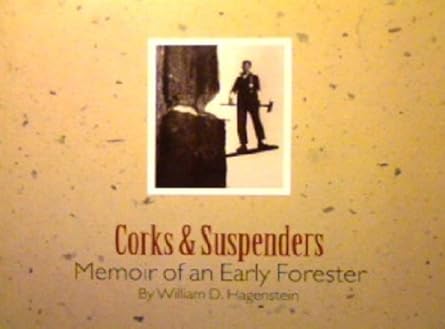
Foresters don’t normally wear corks and suspenders but loggers do. So the title of his memoir was really a tip of his hat to the two professions he admired most. It took him several years and the help of a freelancer to get it done.
Most of us thought he was writing about his IFA years, but he wasn’t. He was writing about those he had known and loved: Greeley, his mother, Jennie, his wife, Ruth, and the institutions that shaped his career: The Tree Farm System, the Society of American Foresters, the West Coast Lumbermen’s Association, Duke University and the University of Washington.
By 1971 – nine years before he retired - Bill was so angry about what environmental extremists were doing to forestry and our nation’s economic well-being that he wrote a fiery essay for Southern Lumbermen magazine titled, “Environmentalists: A New Epidemic.”
Oregon Fish & Wildlife Journal publisher Cristy Rein reprinted Bill’s essay in the winter 2018 edition of his magazine. Here is Bill's Southern Lumbermen essay as it was reprinted in Cristy's Journal.
And here are a few slightly edited quotes that ring as true today as they did when Bill penned them 55 years ago.
Over lunch at his “cookhouse” five years before he died I asked Bill how he wanted to remembered. Without hesitation he modestly replied, “I was a worker in the vineyard. That’s all. Just a worker in the vineyard.”
He was all of that – and much, much more.
Your 100% tax-deductible subscription allows us to continue providing science-based forestry information with the goal of ensuring healthy forests forever.