
Counting the Cost
A congressional inquiry into 19 environmental organizations deserves scrutiny - as do the claims about their litigation practices. Are you a
A congressional inquiry into 19 environmental organizations deserves scrutiny - as do the claims about their litigation practices. Are you a

Rob DeHarpport makes the case for a clear, honest national campaign showing Americans what catastrophic wildfire is costing our forests,
What the hell is wildfire economics? The answer runs from firefighting aircraft and litigation to salvage logging, sawmills, replanting, and

Bob Zybach and I have been friends and co-conspirators since 1994. That was the year I put him on the cover of Evergreen Magazine. There he was, ponytail and John Lennon glasses, looking nothing like what he was or what he would become in the years ahead.
He had been a very successful reforestation contractor in western Oregon. He decided to enroll at Oregon State University in hopes of earning a degree in forestry, with an emphasis on the history of tribal forest management in western Oregon. OSU offered no such degree, so he settled for a PhD in environmental science, awarded in 2003.
My 1994 interview with Bob gave many in the Clinton administration a lot of heartburn. He had critiqued a draft of the Forest Service's Northwest Forest Plan and concluded that its authors were wrong to insist that no information existed to refute their claim that the Pacific Northwest had once been a vast sea of old growth.
Having spent years replanting old clearcuts in the Oregon Coast Range, Bob thought otherwise. Everywhere he looked, there were burned stumps and standing dead trees, clear evidence of a long history of wildfire. Some were caused by lightning, but many were purposefully started by tribal people who had lived in the Coast Range for thousands of years.
The L-shaped kitchen, dining, and living area in the small house he rented near the OSU campus was stacked high with boxes of documents he had accumulated in pursuit of his master's degree.
“Where'd you get all this stuff?” I asked.
“Oh, that's easy,” he replied. “I have a library card.”
His offhand comment enraged the Clinton administration and a cadre of scientists who had worked on the plan. Fortunately, Bob had scientific advisers helping him, none more powerful than the late Robert Buckman, an internationally renowned forest scientist and former director of the Pacific Northwest Forest Experiment Station.
Because Buckman agreed with Bob's assessment, I asked him about the Clinton administration's unhappiness over being publicly challenged by a lowly OSU student. One of its own, botanist Jerry Franklin, had publicly claimed that old-growth forests offered unmatched biological diversity and “species richness.”
Without mentioning Franklin by name, Buckman said, “I will argue that there is as much or more biological diversity in an early seral forest as there is in an old-growth forest.”
About the same time, forest geneticist Bill Libby of the University of California, Berkeley, chimed in with an unceremonious comment concerning the connection between spotted owls, old-growth forests, and plantation forestry.
“Plantation forestry saves more endangered species in a month than most American conservationists save in their lifetimes,” Libby wrote. “As federal logging in the Pacific Northwest has slowed to a virtual standstill, species extinction in tropical forests has accelerated at a thunderous rate.
“Is saving the spotted owl or the marbled murrelet worth the loss of 8,000 to 10,000 species in the Philippines, Malaysia, Indonesia, or Madagascar? Not in my opinion!”
The exclamation point is his, not ours.
Evergreen cannot run on good intentions alone.
Independent forestry journalism takes time, travel, research, interviews, editing, photography, web publishing, and decades of earned trust.
It is work - and like the work you do, it has to be supported.
If Evergreen helps you understand the decisions shaping our forests, communities, and future, please subscribe or contribute today.
Subscribe. Contribute.
Help keep Evergreen independent.
Subscribers receive access to many of Evergreen’s back issues in our Archives.
Our archives hold a deep record of forestry reporting, history, policy, people, and practice.
Looking for a specific issue or topic?
Let us know, and we will help you find the Evergreen
coverage you need.
Prefer PayPal?
You can set up an ongoing donation, and we will honor it as a subscription with the same benefits.
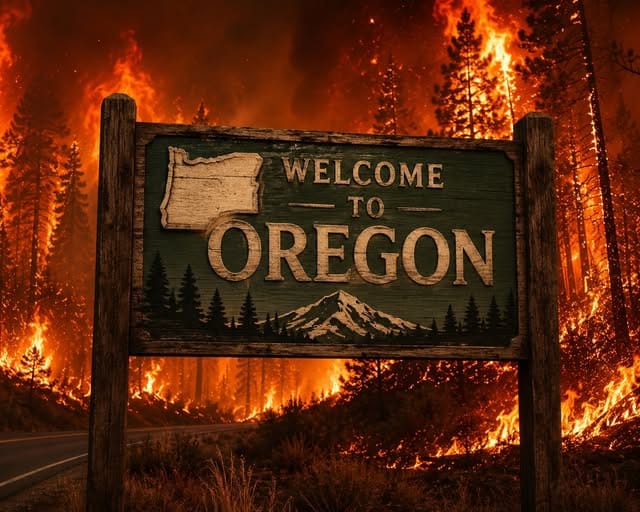
Oregon is in the midst of what appears to be its worst wildfire season on record. By late August, more than 2.5 million acres had burned, surpassing the modern record set in 2024. Oregon is also where the spotted owl wars took shape in the mid-1980s.
The acreage involved in the policies that followed is often blurred. The Clinton administration's 1994 Northwest Forest Plan covered 24.5 million acres of federal forestland in western Oregon, western Washington, and northern California. It established a system of land allocations, including extensive late-successional and riparian reserves, intended to protect spotted owl habitat and old-growth ecosystems.
The 2001 Roadless Rule was a separate national policy. Signed during President Clinton's final days in office, it applied to nearly 59 million acres of inventoried roadless areas across the National Forest System. It broadly restricted road construction, road reconstruction, and timber harvesting, although the rule included exceptions.
The Trump administration has proposed rescinding the national Roadless Rule, but the rule has not yet been rescinded. As of this writing, the public-comment period has been extended into October 2026. A long federal court battle is expected if a final rescission occurs.
The spotted owl war was never only about owls. Old-growth forests were the real focal point. Meanwhile, most of the industrial sawmill infrastructure built to process enormous old-growth logs has disappeared. Only a handful of western mills still operate headrigs capable of handling the largest logs. Most modern mills are designed for sound, high-quality logs, often in the 8- to 24-inch range, with little or no rot. Much of that material now comes from private, state, and tribal forests.
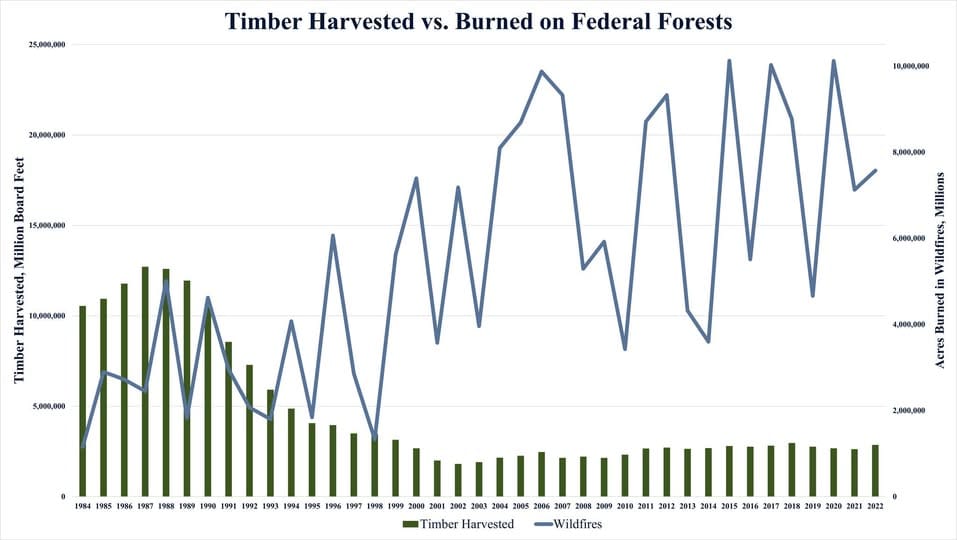
The graph below tells a grim story, and the numbers should give you pause. As federal timber harvests collapsed following adoption of the Northwest Forest Plan, wildfire acreage rose sharply and repeatedly. No single policy caused every fire, but the widening gap is impossible to dismiss.
The cost was measured in more than acres. Forest Service monitoring documented more than 700,000 acres of northern spotted owl habitat lost to wildfire during the Plan’s first 25 years, and the losses have continued. At least 70,000 direct, indirect, and induced jobs disappeared from Oregon, Washington, and northern California.
All of this, and much more, is why Bob Zybach and I have been friends and co-conspirators for more than 30 years. So I was not surprised by last week's email from him.
“Jim, do you have any old Evergreen essays concerning the economics of wildfire that I can republish on the National Wildfire Alliance website?”
After searching through decades of essays, I replied, “No, Bob, I don't, but I'll be happy to do some digging and write something for you.”
“Find something else, then,” he answered. “My interest is in strengthening the connection between Evergreen and NWA, and don't forget to send me your logo.”
“Thanks, Bob. Will do.”
My next email was to Luke Koch, our youngest daughter’s longtime boyfriend. a very nice young man. Luke has a master's degree in forest economics and works for the Bureau of Business and Economic Research at the University of Montana.
“Luke, what the hell is wildfire economics? It seems to me that it covers a multitude of sins, but I'm interested in a real answer from a real forest economist.”
Here is a summary of Luke's answer:
“It's helpful to consider prefire, active-fire, and postfire activity. What sort of economic activity does each period represent? There is the cost of putting out the fire. Then there is salvage logging, sawmill employment, lumber sales, biomass, replanting, and the cost of growing a new forest. Eventually, there is another harvest or another fire, and the process starts again. Then you have to quantify the cost of the policies and regulations that affect all of it.”
Ah, yes. The aforementioned multitude of sins.
Federal wildfire suppression alone costs billions of dollars. The Forest Service reports that suppression by the agency and the Department of the Interior averaged $2.9 billion annually over the last decade. That figure does not include the full cost to people, property, infrastructure, watersheds, wildlife habitat, timber, public health, local businesses, or the years of recovery that follow a major fire.
Some costs are easier to see than others.
We don’t back down when the mission is daunting; we’re in until the fire is out.
The eye-popping cost of aviation includes far more than the aircraft itself. There are flight crews, mechanics, fuel, retardant, tenders, support vehicles, contracts, daily availability charges, maintenance, airports, and dispatch systems.
Aircraft contracts also vary by provider, mission, readiness requirements, and year. The figures below illustrate the scale of the expense. They are not a universal price list.
The C-130 Hercules may be familiar to many readers as the type of aircraft the Marine Corps uses as Fat Albert to support the Navy's Blue Angels. In wildfire operations, the C-130 becomes a very different workhorse. The National Interagency Fire Center describes C-130s dropping approximately 3,000 gallons of retardant in a pass.
Coulson Aviation operates C-130 air tankers and a broad fleet of other fixed-wing aircraft and helicopters. Depending on the aircraft, payload, and contract, estimated operating costs in our review ranged from $5,000 to $6,000 per flight hour for water drops and from $14,000 to $15,000 per flight hour for retardant drops.
Coulson's firefighting fleet includes C-130s, Boeing 737s, Cessna Citations, Bell 412 helicopters, UH-60 Black Hawks, Sikorsky S-61s and S-76s, and CH-47 Chinooks.
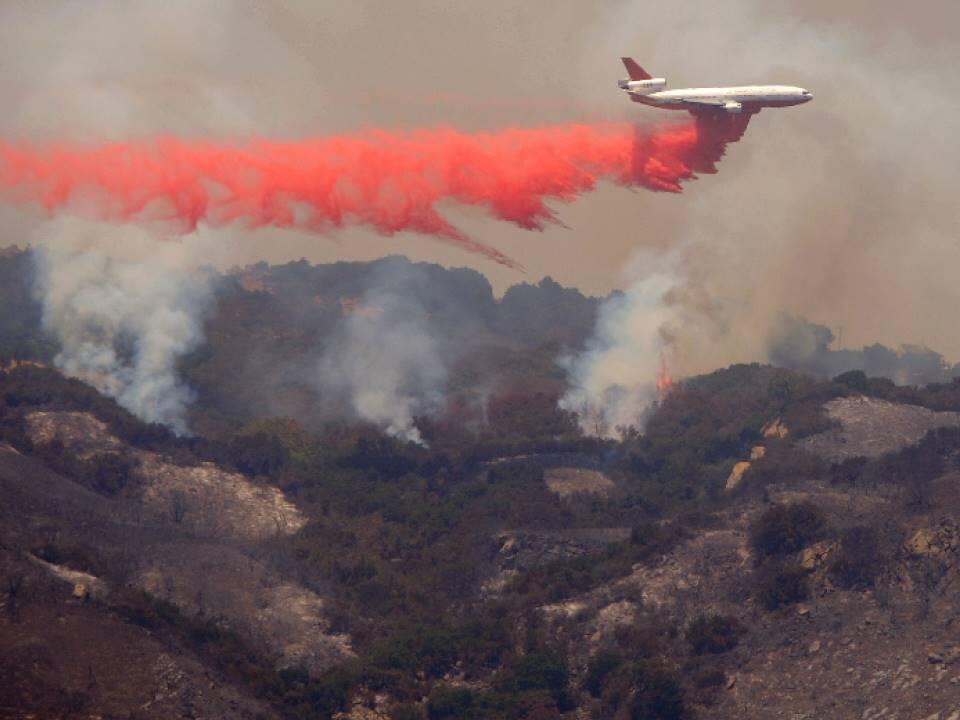
Very large air tankers, including the McDonnell Douglas DC-10, have been contracted at hourly rates ranging from about $8,000 to $22,000, plus daily availability charges that can reach $55,000.
A DC-10 operated by 10 Tanker can carry 9,400 gallons of fire retardant. If Phos-Chek costs $2.50 per gallon, the retardant alone costs $23,500 for one full load, before the cost of the aircraft, crew, fuel, maintenance, and ground support is added.
Helicopter costs range from about $1,000 per flight hour for a small single-rotor aircraft to $10,000 per flight hour for a twin-rotor Chinook. Daily availability charges for a large Chinook can range from $26,000 to $37,500. Those costs cover the flight crew, mechanics, scheduled maintenance, fuel, and fuel tenders.
Dauntless Air operates the AT-802F Fire Boss, an amphibious single-engine air tanker. One contract example priced it at $4,500 per flight hour, plus a $4,500 availability fee.
Its performance is impressive. The Fire Boss can scoop approximately 800 gallons of water in about 20 seconds, operate from dirt or grass airstrips, and repeatedly scoop and drop when a suitable water source is close to the fire. Under favorable conditions, it can deliver roughly 14,000 gallons in an hour.
Using the contract figures above, that first hour works out to approximately 64 cents per gallon delivered, compared with an estimated $5.30 per gallon for a very large air tanker. Cost per gallon is not the only measure that matters, of course. Aircraft are selected according to terrain, distance, payload, speed, water access, airport capacity, fire behavior, and the mission assigned to them.
The federal wildland fire agencies manage between 200 and 300 aircraft, most of them privately contracted. During periods of high fire activity, that force can be expanded with state, local, military, and call-when-needed resources.
Large air tankers are limited to airports with enough ramp space, fueling capacity, loading facilities, and runway length. There are not many of them in the West. Spokane, Billings, Los Angeles, and Salt Lake City come immediately to mind.
By contrast, a Fire Boss can use many small airports and nearby lakes or rivers. In northern Idaho, western Montana, and eastern Washington, that flexibility gives it access to far more operating sites. Fire Boss aircraft fly from several regional airports, including Coeur d'Alene Airport at Pappy Boyington Field, about five miles from our home.
The first report is part science and part policy. It was written primarily by Bob Zybach and the late John Marker, a longtime friend and former Evergreen board member. John led public relations for the Forest Service's Region 6 office in Portland during the spotted owl wars. He was a very classy guy and a true gentleman.
It is thoughtful and well worth reading, particularly for its treatment of forest policy.
The second report focuses on the nuts and bolts of wildfire economics.
The third confirms what many of us fear about the West's wildfire crisis.
Consider the cost of an experienced attorney at $500 per hour, hired to convince a federal district court judge that the Forest Service adequately documented the effects of a proposed salvage timber sale. Only then can a timber purchaser recover burned federal timber tied up by litigation. Some of these court battles continue for months, and the timber purchaser pays the legal bill.
Under the Equal Access to Justice Act, a prevailing party may recover attorney fees from taxpayers when the government's position is not substantially justified. Critics argue that the law can help underwrite repeated litigation by organizations such as Mike Garrity's Montana-based Alliance for the Wild Rockies and the Center for Biological Diversity, which has offices across the country.
If the timber purchaser prevails, the costs continue:
Rising mortgage interest rates, about 7 percent at the time of writing, are having a significant negative impact on home construction. Prices for dimension lumber and plywood change daily. Last week's quoted average for dimension lumber was about $633 per thousand board feet, depending on the species.
Prices for laminated veneer lumber, I-joists, glulam, and oriented strand board range from approximately $4 to $35 per linear foot, depending on the product and species.
Mass plywood panels can range from $40 to $50 per square foot, but building a mass plywood panel plant can cost 10 times as much as building a high-speed small-log sawmill. A small-log mill may cost $15 million, compared with $150 million for a mass plywood panel plant, excluding the land.
Freres Engineered Wood can tell you all about this. The company began with Austrian technology, then modified it to fit the size and quality of timber harvested from its own land and from state and private forests.
Then there is the eye-watering cost of building a biomass plant to process wood waste. Depending on the scale and technology, estimates range from $200,000 for a very small system to $1.35 billion for the big kahuna. On the other end of the supply chain, a 40-pound bag of home-heating pellets sells for at least $6.
So there you have it, Bob: wildfire economics with a dollar sign, and I still have not counted the cost of the heartburn.
For that, add $4.98, plus tax, for a 60-count bottle of Extra Strength Rolaids at Walmart.
You can add all of this up if you want to, Bob. I didn't even try.
Take care,
Jim
Your 100% tax-deductible subscription allows us to continue providing science-based forestry information with the goal of ensuring healthy forests forever.