
What Wildfire Smoke Carries
Fire ecologist Leda Kobziar on living microbes, public health, and why wildfire smoke must become our responsibility. Coughing and struggling
Fire ecologist Leda Kobziar on living microbes, public health, and why wildfire smoke must become our responsibility. Coughing and struggling

How Wildland Fire Policy Shifted Danger from Firefighters to Everyone Else - and How the Forest Service Lost the Public Along
In this issue, we follow the rest of the money - examining who funds the organizations filing these lawsuits and what their donors may not know about the consequences.


Evergreen Foundation board member Ted Stubblefield died Saturday evening, July 25, at his home in Prescott, Arizona. His wife, Mary, was at his side.
Ted was 85 and had been in declining health for several years, but he never missed an Evergreen Foundation board meeting.
We first interviewed Ted not long after he joined our board in 2016.
Ted, Rich Stem, and Phil Aune - also Evergreen board members - worked together at various times during their long careers with the U.S. Forest Service.
They were all cut from the same cloth: tough but fair men who joined the agency in an era when upholding its mission was Job 1. They did not suffer fools gladly.
It’s like losing a brother, Aune said of Stubblefield’s death. We were buddies during our years at Humboldt State College in the early 1960s, and then we worked together in California’s National Forests. I never worked outside Region 5 during my career. Ted did.
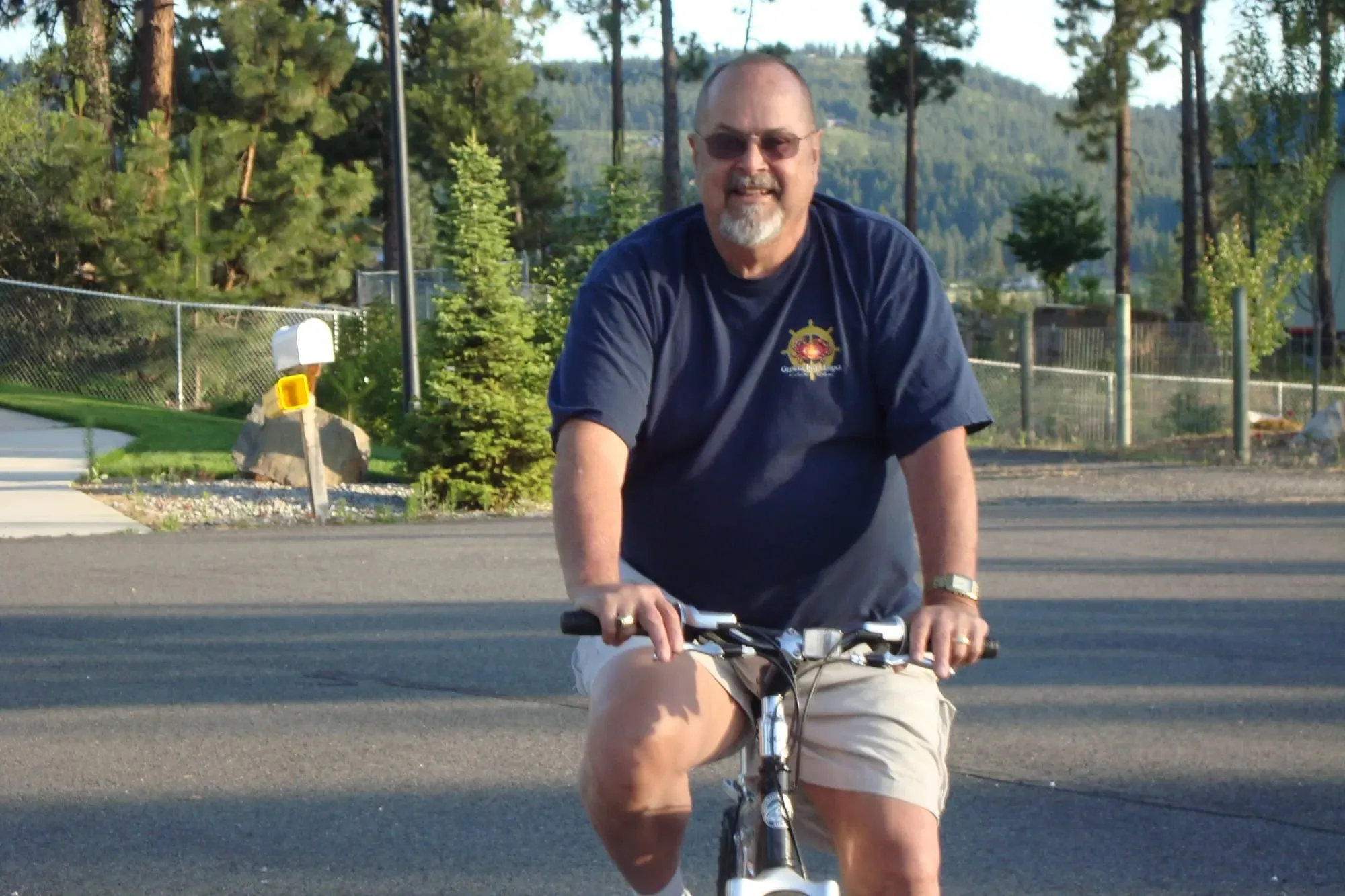
“We were all old-school guys,” Ted told me when we last interviewed him. “Job 1 was to meet your timber sale targets. But that had a very different meaning than many assume. We were never out there whacking down trees for the fun of it.
“As late as the 1970s, timber sales were hard targets associated with well-developed, detailed forest management plans, harvest plans, timber purchase agreements, monitoring, and rapid replanting.
“These targets became impossible to meet during the spotted owl wars of the 1980s and 1990s because of timber sale appeals and litigation. It was a very frustrating time for those of us who believed the only way to grow forests and protect them from insects, diseases, and wildfires was to manage them properly and replant as quickly as possible after logging or wildfire.”
Ted’s 38-year career with the Forest Service stands in stark contrast to the litigation-driven wreckage that current Chief Tom Schultz is attempting to reassemble amid internal unrest, public unhappiness with the West’s wildfire pandemic, and continuing serial litigation by a conflict industry that routinely abuses the Equal Access to Justice Act.
“Even in retirement, my main concerns are still focused on the regulations and policies that have led to the loss of millions of acres of old growth and second- and third-growth forests planted by my crews and others during my era,” he told us in 2016. “I don’t think most people understand what’s being lost or the hundreds of years it will take to get it back.”
Ted grew up on an avocado farm in Southern California. Planting, thinning, and pruning went on seven days a week. Hard work, for sure, but it - and summer vacations in the Sequoia National Forest - inspired Ted’s interest in a forestry career.
“It just seemed like the natural thing to do,” he told us.
He fought his first wildfire in 1961 on a Timber Stand Improvement crew during his freshman year at Humboldt State College in Arcata, California. He graduated in 1964 with a major in forest management and a minor in wildlife management.
Ted’s first permanent job with the Forest Service was as a Forestry Technician, but he was soon promoted to a GS-5 Junior Forester on California’s Hot Springs Ranger District. Even then, having a job with retirement and health care benefits was very much on his mind.
“Between 1961 and 1981, I rose from crewman to command Type 1 fire teams, serving as Plans Chief, Line Boss, and Type 2 Fire Boss.”
Ranking in wildfire command was based on experience, so it was unusual for someone to rise as quickly as Ted did. But the Forest Service saw a tough young man who took no prisoners and got things done quickly on firelines.
Soon enough, he was promoted to Timber Sale Administrator on the Sequoia National Forest’s Cannell Meadow Ranger District. It included the 950-square-mile Kern Plateau. At elevations ranging from 6,000 to 12,000 feet, it was a favorite destination for Southern Californians anxious to escape the valley heat.
“Congress had been discussing management options, including a no-harvest reserve, on the Plateau for decades. As Timber Sale Administrator, I was responsible for the biggest logging operation then underway in Southern California. Forty log trucks per day.
“I memorized our sale contracts and read a 60-inch-tall stack of congressional paperwork that helped me understand what was necessary,” he recalled. “Job 1 was to meet your assigned annual timber target. We worked our tails off.
“Phil Aune, who is on your Evergreen board, was our sale preparation guy. Hard work made us stronger. We could all do all the jobs. We loved it. No one ever complained.
“I wasn’t an armchair guy. I preferred being in the brush where the things that were my responsibility occurred. Being stuck in an office drove me nuts.”
When Ted started working on forest plans, there were no decadal forest plans, computers, or GIS maps. Crews prepared unit plans using what the Forest Service called “Idea Books” - pocket-sized books that fit into shirt or jacket pockets.
“I had dozens of them,” he recalled. “One for each timber sale, described in detail.”
After the National Forest Management Act was enacted in 1976, Region 5 - which included California and Hawaii - hired hydrologists and soil scientists to work across California’s 18 national forests.
“NFMA mandated forest plans that balanced timber harvesting against all other forest resources, including soil, water, and fish and wildlife habitat. It was the precursor to the decadal forest plans.”
All hell broke loose in Region 6 as the Forest Service began implementing the National Environmental Policy Act and its subsequent regulations because annual timber harvest targets became increasingly difficult to meet.
“It was less of a problem in Region 5,” Stubblefield recalled. “We were more multiple-use oriented - mainly selection harvesting. There was not nearly as much public controversy as clearcutting produced in Region 6 forests in western Oregon and Washington.
“You were well advised to meet your timber target or explain why you were being sued. Emotions ran very high in every national forest west of the Cascades in Washington and Oregon.”
NEPA was the genesis of mandated Environmental Impact Statements and Environmental Assessments that have become cannon fodder for taxpayer-paid serial litigators employed by anti-forestry groups under the aegis of the widely abused Equal Access to Justice Act.
Ted’s long career took him from Region 5 in California to Region 6 and the Siskiyou National Forest in Grants Pass, Oregon.
This is where I met him in 1979. He was the tough, straight-talking man who had been described to me several times.
“It was a wild and woolly era,” he said. “The Forest Service was nearly 10 years into implementing NEPA, and environmental review had resulted in required 100-foot buffers on both sides of five rivers. Region 6 leadership in Portland was still turning a blind eye to big clearcuts and high-lead logging cables dragging big logs through spawning streams.
“We stopped all of that with contract changes.”
Ted’s final stops were as Forest Supervisor on the Olympic National Forest in Washington from 1985 to 1991 and as Forest Supervisor on the Gifford Pinchot National Forest from 1991 until his retirement in 1999.
On the Olympic, he supervised a staff of 250. He found the same riparian problem he had seen on the Siskiyou and “fixed it in a hurry.”
From the Olympic, Ted transferred to the Gifford Pinchot, one of the most controversial national forests in Region 6. He managed a $55 million annual budget, 650 permanent employees, and 1,500 temporary employees.
“Fortunately, I had Rich Stem, also one of your Evergreen directors, as my Timber Staff Officer,” Ted recalled. “I knew what kind of guy he was. I could hand him the toughest jobs, get the hell out of his way, and he could usually fix the problem.”
Ted’s confidence in Stem was well placed. Years later, Rich demonstrated the same old-school determination following the 2013 Rim Fire - confronting an enormously complex salvage project, navigating the EIS and EA Rubik’s Cube, and still getting the work done.
I had seen this hat trick once before. Jim Torrence, then Region 6 Regional Forester, sent Rich to Grants Pass, Oregon following the 1987 Silver Fire. He picked him after discussions with Ron McCormick, then Siskiyou Forest Supervisor and - guess who - Ted.
Silver destroyed most of 96,000 acres of old growth timber on the Siskiyou National Forest. His job was to supervise development of an EIS that would permit the salvage of about half what was burned. He did it - much to the astonishment of every lumberman in southern Oregon. None of them thought salvage was possible.
It was. Here's the August 1988 program that Evergreen assembled for the Saturday, August 27 Silver Fire Roundup in Grants Pass. More than 1,600 log trucks from five states showed up. American Trucker Magazine later said it was the largest peacetime convoy in U.S. history. Satellite news trucks from Portland beamed to event to the nation.
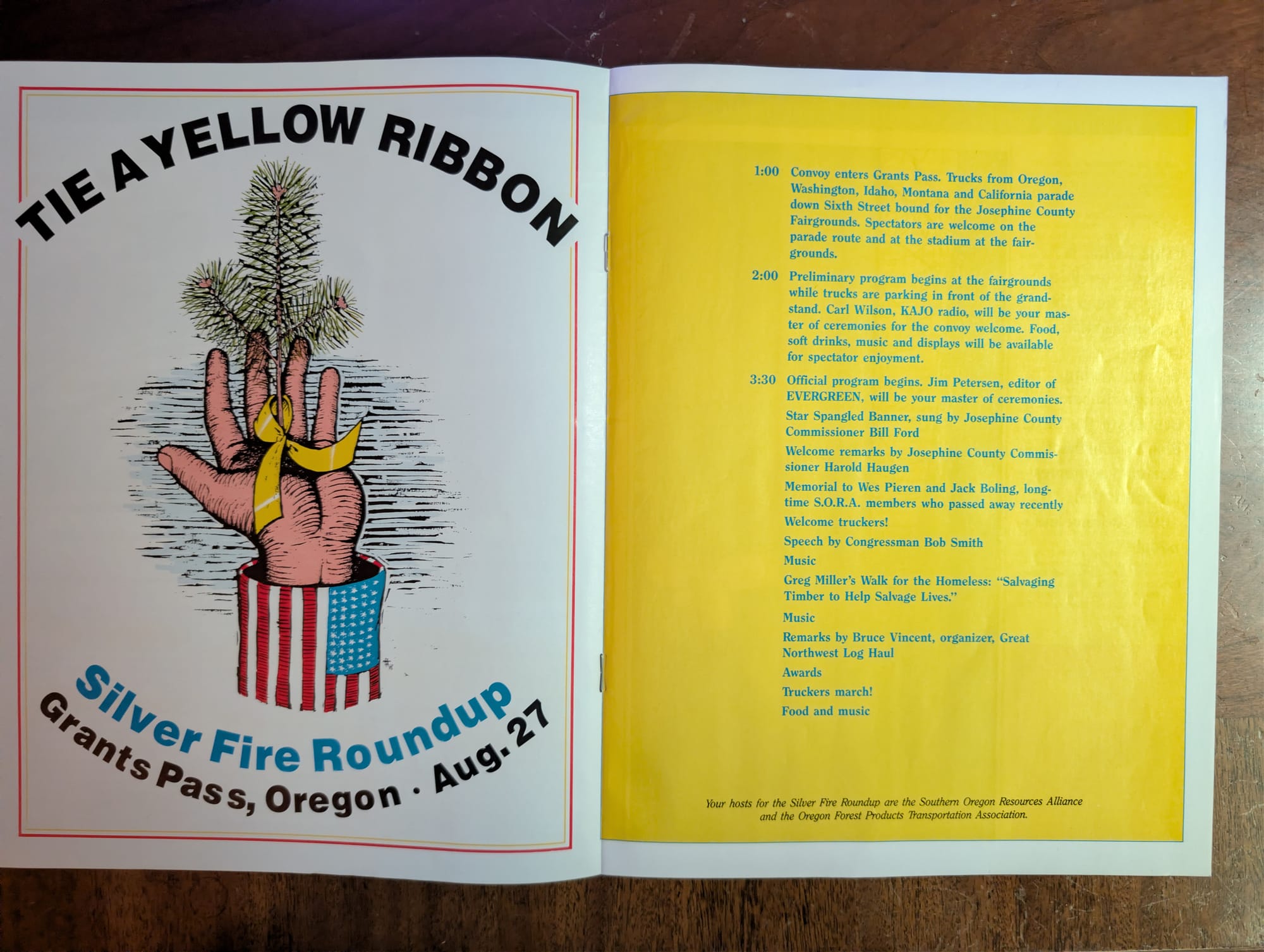
Bruce Vincent, now Evergreen's treasurer, gave his fabled "It's Okay To Be A Logger" speech and and Bob Smith, Oregon's Second District congressman flew in from eastern Oregon on a private jet to ask his fellow congressmen to support Rich's burnt timber salvage plan. At his urging, more than 22,000 people wrote letters to the Forest Service endorsing Rich's EIS.
Thanks to subsequent taxpayer paid litigation, thousands more owl nesting sites were lost in subsequent reburns on the Siskiyou. No one - not ever Ted - could stop the carnage litigators created.
The northern spotted owl was listed as threatened species under the aegis of the federal Endangered Species Act in 1990. The Northwest Forest Plan followed in 1994. After its implementation, the West’s federal timber sale program continued its slow-motion collapse. More than 70,00 woods workers lost their jobs.
Anti-forestry activists blamed mill automation for the losses, but the record shows that more jobs were created by automation than were lost. Today, sawmills in western Oregon and Washington are a marvel to behold. Machines now do all of the heavy lifting mill workers had done for decades.
When we last interviewed Ted, he recalled the cascade of events that immediately followed the owl listing and the subsequent Northwest Forest Plan.
“In the ’60s, ’70s, and ’80s, our workforces hit the deck running to meet our hard targets. By the time the owl wars ended, harvest levels in Region 6 had fallen 85 to 88 percent, and even those reduced targets were not met because of litigation.
“Worse, there were no standards for measuring job performance. You winged it and hoped not to get sued. Most of the agency’s forest management budget was spent on fire lines. The underlying causes of our increasingly frequent and destructive wildfires weren’t being addressed.”
As for Rich Stem, he did finally solve the EIS and EA Rubik’s Cube. He did it in the aftermath of the 2013 Rim Fire, a 257,314-acre colossus that burned across the Stanislaus National Forest and neighboring lands.
Twenty-five spotted owl nesting sites were lost, but Stem’s handpicked salvage planning team accounted for them in its documents. Some 210 million board feet of timber were harvested.
It was precisely the kind of difficult assignment Ted knew he could hand to Rich and then get the hell out of his way. Both men believed the Forest Service’s myriad responsibilities did not end when the flames went out. The work of recovering, replanting, and restoring the forest still had to be done. It still does.
Here's what Rich said about Ted...
We all have heroes in our relationships, our careers, and essentially our lives. In my career, Ted Stubblefield was one of my heroes.
We all have heroes in our relationships, our careers, and essentially our lives. In my career, Ted Stubblefield was one of my heroes.
I was fortunate to be working for the Forest Service for a relatively short 28 years. I did other things before that, but as a Forester, it did not get any better than that. The highlight was working for the country to help manage its resources, but the other highlight was working with incredible people who cared and strongly demonstrated it every day.
I had some incredible mentors and leaders that I was blessed to work for over time, and Ted was one of them. I worked with Ted on the Siskiyou and again directly for him for 5 years as his Timber/Planning Staff Officer. I knew him well.
When we had to downsize the Forest due to the Northwest Plan, Ted led the charge for us in the outplacement of the employees, but CARING about how we did that. He insisted on total teamwork from his management team in that difficult task. He was a master at leading us through that tough issue, and we got it done in record time, all the while maintaining commitments to the resource.
He was undoubtedly one of the most courageous men I have known.
He made bold decisions, stood firm when it mattered, and expressed his opinions to anyone with conviction whenever they were needed. He would always say, “Do the right thing.
He had the capacity to be both rough at times and incredibly kind in others. He always endeavored to balance that as needed. He had my back many times when I did something foolish but always reminded me to “learn from it.”
At times he would simply advise, but at other times he would direct as needed. His sense of humor was ever present and taught many people the value of humor right from the top, but never confuse that with hard work. It made people at ease when they needed to talk to him, even if serious.
He was never shy about personnel issues and set a strong example to all to always be fair but clear on expectations. I could likely go on for a long time, but alas, I won’t.
He balanced the fine line of boss and friend, and after going on with my career, we remained friends with him and his wife Mary. He always asked about my family, and we communicated frequently up until a month ago.
Ted was the front-and-center illustration of 2 famous quotes: “Leadership is being Present” and “Leadership is action, not proclamation”.
I will deeply miss our discussions and interactions, but he will always remain in my heart.
Ted Stubblefield belonged to a Forest Service generation that believed responsibility was personal, work was meant to be completed, and the condition of the forest was the final measure of success.
He never stopped worrying about the forests he and his crews had managed, replanted, and protected. He never stopped warning us about what was being lost. And despite years of declining health, he never stopped showing up for Evergreen.

You can set up a single or ongoing donation in Ted's name. Make sure to Include the word "Ted" on your donation. You can also contact Julia Petersen at julia@evergreenmagazine.com if you need assistance.
'
Your 100% tax-deductible subscription allows us to continue providing science-based forestry information with the goal of ensuring healthy forests forever.