
Defining wildfire economics
What the hell is wildfire economics? The answer runs from firefighting aircraft and litigation to salvage logging, sawmills, replanting, and
What the hell is wildfire economics? The answer runs from firefighting aircraft and litigation to salvage logging, sawmills, replanting, and

Fire ecologist Leda Kobziar on living microbes, public health, and why wildfire smoke must become our responsibility. Coughing and struggling
How Wildland Fire Policy Shifted Danger from Firefighters to Everyone Else - and How the Forest Service Lost the Public Along

I've been around. That is a war zone. When you look at the devastation and the damage you know some of these folks may not recover."
Major General Welsh describing the devastation he witnessed when he toured the the devastation in Spokane, Washington’s wildfires on Sunday, August 2.
I spent a lot of time around Spokane when I was a youngster. My paternal grandmother owned an apartment house on West Fourth and two city blocks between West Second and West Third. She rented to car dealers.
I was her only grandson so I was royalty. At 82, I still have vivid memories of all the wonderful things we did together. She and Bing Crosby’s mother were friends, so we scored loge seats for the Spokane premier of White Christmas. Crosby grew up in Spokane and starred in the movie. Julia and I still watch it every year.
For years. my grandmother’s sister, Nora, ran the coffee shop at the Historic Davenport. She was one of Louis Davenport’s longest serving employees and she introduced me to him the year before he died in his top floor suite. I was six.
These memories and many more came rushing back to me when Spokane’s firestorm broke out in a lovely residential area in Northwest Spokane on
Saturday afternoon, August 1.
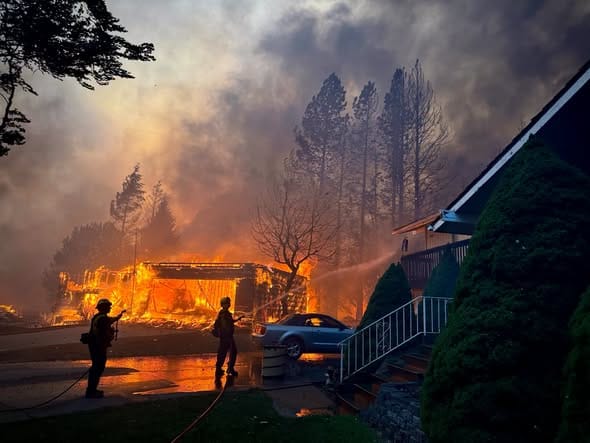
At this Tuesday morning writing, perhaps 1,100 homes have been lost in a cluster of fires that have devastated beautiful tree-lined neighborhoods and nearby ponderosa pine forests. There is still zero containment.
Our own Coeur d’Alene Fire Department sent trucks. Other nearby communities did, too. Firefighting teams are being flown in from all over the nation. The tragedy is still unfolding. Lots of tears as homeowners search for what’s left of their homes. Mostly smoldering foundations.
No deaths have been reported yet but many people are missing. On vacation or in the ruins? No one knows.
When Washington National Guard Adjunct General, Gent Welsh, toured the devastation on Sunday evening, August 2, he described it as a “war zone.” He should know. His 38-year Air Force tour of duty took him to Iraq, Sarajevo, Bosnia, Herzegovina and NATO headquarters in Brussels, Belgium.
Last night's acreage report from the fire lines was tells me this cluster of wind-driven fire is moving very fast: Old Trails, 3,619 acres; Autumn Lane, 3,351 acres and Fairview, east of Spokane, 1,052 acres.
So far, 700 to 1,100 homes have been destroyed and 65,000 people have been evacuated. That’s almost 6,500 more people than live in Coeur d’Alene, Idaho, where we live.
More than 8,000 acres of dry grass and trees are black. These fires are now the nation's No. 1 wildfire priority. Crews are flying in from several states. FEMA is mobilizing, Red Cross workers are deployed on multiple fronts and donations of food, water and cash are flowing in rapidly. Several shelters have been set up, including one at the Spokane County Fairgrounds that can handle livestock.
Yesterday, Aaron Farinacci, Spokane, was booked into the Spokane County Jail on suspicion of first-degree arson in connection with the Old Trails Fire. In 2010, he was imprisoned in Arizona for killing his father.
What lessons can homeowners learn from this wildfire tragedy?
Preparedness is vital if you live in a fire-prone area. “Get Ready” and “Go Now” mean exactly what they say. Figure out what’s really important and get it packed into your car: Important family records, financial records, insurance policies, photos and heirlooms. Whatever you don’t want to lose.
Forget about standing on your roof with a garden hose. Wind-driven flames can travel the length of a football field in seconds.
You can “Firewise” your home. Firewise USA is a free national program run by the National Fire Protection Association. It is backed by the U.S. Forest Service most state forestry departments.
Google "Firewise" and you will find a wealth of information including illustrations that show you how to clear a buffer around your home.
There is also information concerning fire resistant plant species that grow well in USDA Hardiness Zones 6A and 7B.
Keeping the trees on your property trimmed is also very important. Sparks traveling on winds can ignite low hanging limbs that become “ladder fuels” that push flames into tree crowns. Crown fires spread quickly. This is how entire neighborhoods can do up in flames in a matter of minutes.
We don’t back down when the mission is daunting; we’re in until the fire is out.
The Spokane wildfire complex is not the first in eastern Washington. Nor will it be the last. The area's dry site ponderosa forests stretch west for about 30 miles.
The land ownership pattern is varied but it is not hard to tell who owns what. If the trees have been thinned the forest belongs to a Tree Farmer or Washington’s Department of Natural Resources.
In recent years, there have been two difficult neighborhood wildfires in the area west of Spokane. The 2023 Gray Fire near Medical Lake burned 10,000 acres and 259 homes. It was caused by a faulty outdoor light owned by Inland Power and Light Company. The 2014 Watermelon Hill Fire near Cheney burned 13,000 acres. It was caused by three people shooting at exploding targets.
We’ve been writing about wildfires and forests on this website for 40 years. We’ve seen every imaginable cause and its result. Some fires are the result to stupid mistakes. Others happen because we love living in homes near forests.
No matter what the cause of a wildfire, it is very important to remember that nature is nature. It doesn’t care about you, your kids and grandkids, your home, your neighborhood or the family dog or cat.
Here's some sage advice from an old friend: PhD wildlife biologist Alan Houston. Alan runs the Ames Plantation's forestry operation in Grand Junction, Tennessee:
“When we leave forests to nature, as so many people seem to want to do, we get whatever nature serves up, which can be pretty devastating at times, but with forestry we have options, and a degree of predictability not found in nature.”
Please Firewise your home and be prepared to evacuate at a moment’s notice. The lives of your family members and friends are in grave danger.
Some will blame the Spokane Complex on climate change. Yes, the climate is changing. It has been for millions of years. The University of Arizona Laboratory of Tree Ring Research has tracked the West’s climate in reverse for more than 2,000 years. https://ltrr.arizona.edu/
We encourage you to look at this very informative website. For eons, there are been very long warming and cooling patterns with imbedded mini-cycles in the Pacific Northwest.
Tree growth accelerates in warm years and slows in dry years. Thick-barked ponderosa pine handles most wildfires quite well. Thin-barked white fir dies quickly in wildfires but grows like crazy in wet years.
Long range National Weather Service forecasts suggest we are headed into a warming pattern, meaning not much snow this winter and a lot of rain. It will come as a welcome relief from what we are witnessing.
Later this month, we will bring you a riveting interview with Leda Kobziar, a PhD ecosystems scientist at the University of Idaho. Much of her current research involves bacterial microbes that travel in carcinogenous wildfire smoke.
Actively managing forests reduces wildfire risk. In eastern Washington, northern Idaho and western Montana this means selection harvesting, prescribed burning and scattered clearcuts that replicate historic fire patterns.
Lots to know and do before the fire next time.
Your 100% tax-deductible subscription allows us to continue providing science-based forestry information with the goal of ensuring healthy forests forever.