
Keep Our Forests Green!
Rob DeHarpport makes the case for a clear, honest national campaign showing Americans what catastrophic wildfire is costing our forests,
Rob DeHarpport makes the case for a clear, honest national campaign showing Americans what catastrophic wildfire is costing our forests,

What the hell is wildfire economics? The answer runs from firefighting aircraft and litigation to salvage logging, sawmills, replanting, and
Fire ecologist Leda Kobziar on living microbes, public health, and why wildfire smoke must become our responsibility. Coughing and struggling

Dick Bennett and I were good friends for many years.
I’ve never known another lumberman quite like him. Not even close.
He was easily the kindest and most generous man I’ve ever known.
And he had the heart of a warrior...Dick would not back down from any challenge that impacted his sawmilling business, his family, or his friends.
I no longer remember when we met. Sometime in the early ’90s.
Back then, we printed 25,000 copies of Evergreen Magazine monthly.
Our contributors - save one - were all western Oregon lumbermen and loggers.
The “one” was Keith Olson, the now-retired leader of the Montana Logging Association.
Out of the blue, Dick called me one morning with a passel of questions.
“I have a copy of your magazine in front of me. Who supports you?”
“Mostly lumbermen and loggers in western Oregon,” I replied.
“Anyone else?” he asked.
“The Montana Logging Association,” I said.
“Who in Idaho?” he asked.
“No one, Dick,” I replied.
I knew Dick by reputation, but we’d never met.
He was already a legend, mostly as the leader of the U.S. Softwood Coalition.
Despite his Alberta birthright, Dick hated the fact that Canada’s timbered provinces gave logs to Canadian lumbermen. Their unwritten agreement with the provinces allowed them to undercut U.S. lumber prices.
Federal timber purchasers in the U.S. bought timber at Forest Service and BLM auctions and often paid more for logs than they were worth, just to keep running. The only survivors were the companies that invested in advanced sawmilling technologies that allowed them to recover more lumber from each log they sawed.
Dick got his start in the lumber business in his parents’ basement in Clarkston, Washington, when he was maybe six or seven years old. To make ends meet, his father started making packing boxes for local fruit orchards. I don’t recall what Dick did, but when World War II broke out, the family added ammunition boxes to the mix, and the Bennett Box Factory was born.
Postwar demand for lumber for the West’s housing industry led to construction of the first Bennett sawmill. More would follow.
“Would you be willing to drive to Coeur d’Alene to tell me more about Evergreen and your plans for expanding?” Dick asked the first time we talked by phone.
“Sure. When?”
“How about tomorrow?”
I would soon learn three things about Dick that I admired greatly:
“We need to educate Idaho’s elected officials,” Dick told me moments after I walked into his home office on Hayden Lake. “Environmentalists have their attention. We don’t.”
And with that, he handed me a check for $5,000.
It was more than any lumberman had ever donated to Evergreen in one check.
“I’d like to continue our conversation next month, and I’ll have another check for you.”
“How can I help you?” I asked.
“Just keep doing what you are doing. Something will come up. It always does.”
Thus began our long friendship. I have no idea how much he donated to Evergreen over the years we worked together, but it ran well into six figures.
Most lumbermen eschew interviews. Dick did not. He was a natural leader with a well-honed gift for gab. He granted hundreds of interviews to journalists. I don’t know how many times he testified before U.S. House and Senate committees, but his Rolodex held contact information for every congressman who had influence over federal forestry legislation and policy formation.
Dick was also a great teacher.
“Ever seen a pine beetle?” he asked me in one of our many long conversations.
“No, I haven’t,” I replied. “Pine beetles don’t attack Douglas-fir.”
Days later, we were standing on some of his timberland near Elk City, Idaho.
He pulled a jackknife out of his pocket, dug a beetle out of the bark on one of his trees, and dropped it in the palm of my hand. It leaped to the ground at my feet and was gone in a flash.
“That’s a pine beetle,” he said. “They fly here from that forest right over there,” he said, motioning to a tract of dead timber on the neighboring Clearwater National Forest.
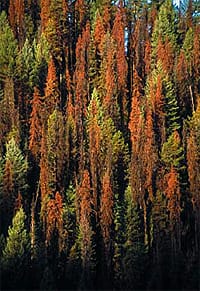
“The Forest Service isn’t doing a good job of managing its timber, and the result is killing my timber,” he explained. “We have to convince Congress that acquiescing to environmental groups that don’t want federal forests managed is lousy forest policy.”
Thirty-some years later, “we” are finally moving the needle in the right direction, the “we” being the American Forest Resource Council, Nick Smith’s Healthy Forests Healthy Communities project, the reborn National Wildfire Alliance, and Evergreen.
We are plowing deep in the common ground we share.
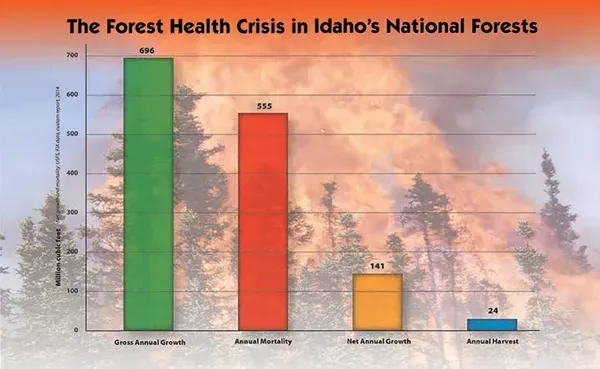
We are still outgunned by the billion-dollar conflict industry, but we are gaining ground thanks to Forest Service Chief Tom Schultz.
I don’t know if Tom and Dick ever met, but if they did, Tom knows there is no one in the Trump Administration tougher than Dick, including the President.
Dick’s toughness, money, and determination are the main reasons the Idaho Forest Group exists. He helped company owner Marc Brinkmeyer get started.
Today, IFG is the 10th-largest manufacturer in the U.S. and, by far, the largest log buyer in Idaho.
The company owns mills at Chilco, Laclede, Moyie Springs, Lewiston, Grangeville, and Athol - all in Idaho - and its newest and largest mill is in Lumberton, Mississippi. It is thought to be one of the most technologically advanced dimension lumber mills in the Southeast.
Dick was an adventurous soul.
He loved Alaska’s beauty, and he enjoyed touring with his friends and family aboard the Polar Express, a 99-foot yacht he owned for several years.
He enjoyed sharing his considerable wealth with those he loved and with the communities he cared about. After his son Richard Guy Bennett Jr. was killed in a car wreck, Dick funded construction of the Boys & Girls Club in Clarkston in his memory.
Dick is survived by his wife, Aliede, 20 grandchildren, 39 great-grandchildren, and eight great-great-grandchildren.
His grandchildren include Scott Atkison, who worked closely with Dick in the family lumber business and eventually ran Bennett Forest Industries’ Grangeville sawmill. When Bennett Forest Industries merged with Marc Brinkmeyer’s Riley Creek Lumber in 2008 to form Idaho Forest Group, Scott became the new company’s president and CEO, while Dick served on its board. Together, they carried the Bennett family’s sawmilling legacy into a new generation.
Dick was preceded in death by his parents, Guy and Millie Bennett; his first wife, Jeanne; his second wife, Joanne; two brothers; an infant son; a grandson; and his firstborn son, Richard Guy Bennett Jr.
I will miss Dick’s indomitable spirit more than words can ever say. Somewhere beyond our sight, I like to think there is good timber, a mill running true, and another challenge waiting for him.
Subscribers receive access to many of Evergreen’s back issues in our Archives.
Our archives hold a deep record of forestry reporting, history, policy, people, and practice.
Looking for a specific issue or topic?
Let us know, and we will help you find the Evergreen
coverage you need.
Prefer PayPal?
You can set up an ongoing donation, and we will honor it as a subscription with the same benefits.
Your 100% tax-deductible subscription allows us to continue providing science-based forestry information with the goal of ensuring healthy forests forever.