
Defining wildfire economics
What the hell is wildfire economics? The answer runs from firefighting aircraft and litigation to salvage logging, sawmills, replanting, and
What the hell is wildfire economics? The answer runs from firefighting aircraft and litigation to salvage logging, sawmills, replanting, and

Fire ecologist Leda Kobziar on living microbes, public health, and why wildfire smoke must become our responsibility. Coughing and struggling
How Wildland Fire Policy Shifted Danger from Firefighters to Everyone Else - and How the Forest Service Lost the Public Along

The West is on fire again this summer.
I’ve lost track of the number of times I’ve started an essay with this sentence.
The 1990 spotted owl listing marked the beginning of a new era in western forest policy. It did not create today’s wildfire crisis by itself, but it opened the door to decades of litigation, regulatory restrictions, and political decisions that steadily reduced active management on federal forests.
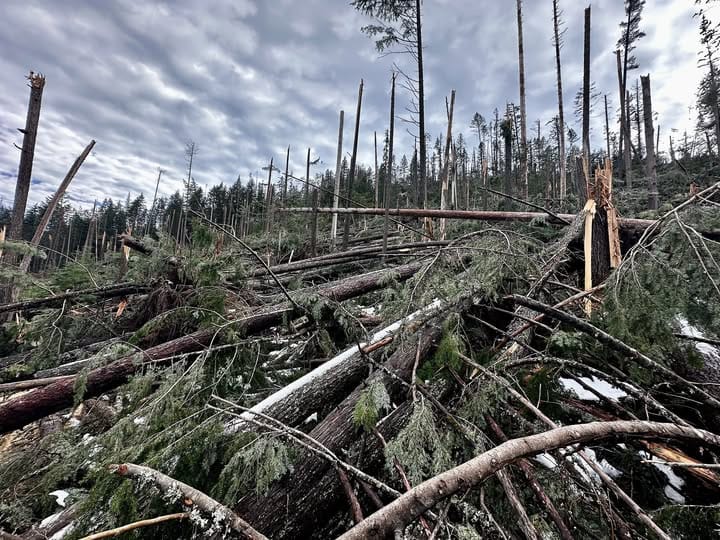
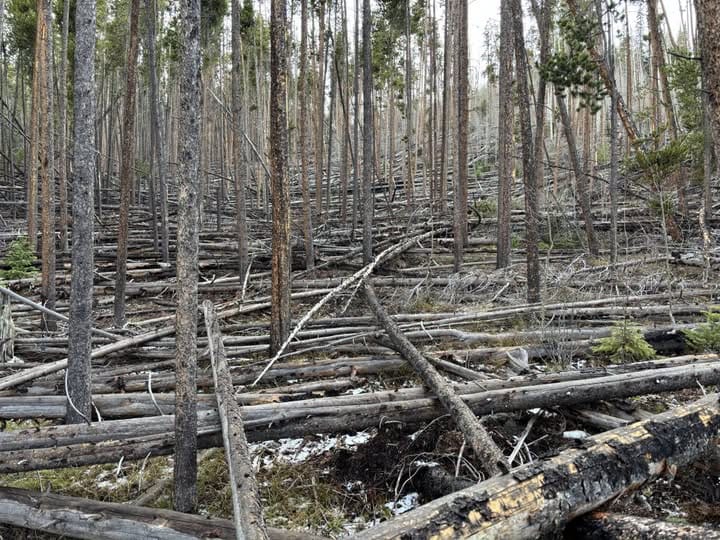
The consequences accumulated slowly: overcrowded forests, expanding insect and disease infestations, enormous fuel loads, and federal agencies increasingly unable to act before fire did the work for them.
The U.S. Forest Service and Bureau of Land Management were hamstrung by serial litigators and their taxpayer-paid lawyers.
More than three decades later, the results are burning before us.
Public opinion is finally turning against the policies and litigation that helped create this crisis.
We have a helluva environmental mess on our hands.
The National Interagency Fire Center in Boise, Idaho, keeps track of this mess daily. Statistics on its website will set your head spinning. Today, the center reports that wildfire crews are battling 49 uncontained wildfires: Alaska, eight; California, five; Colorado, six; Minnesota, six; Oregon, five; Utah, five; and Idaho, three.
Another 158 fires were reported nationally on July 15. Thus far this year, 3.67 million acres have been scorched in 39,764 fires - more than in any year since 2022 - and the three worst fire months are still ahead of us.
The all-too-familiar rhythm of this can be seen and heard in daily reports from the East Evans Creek wildfire in southern Oregon. The July 17 morning briefing described swirling winds and spot fires three miles from Shady Cove, a bucolic Rogue River enclave 34 miles north of Medford. Dozers, hand crews, engine crews, helicopters, and borate bombers are battling what Oregon Governor Tina Kotek calls “a conflagration.”
She is correct.
About 11,500 acres of timber have been scorched. Containment is a hard-fought five percent. “Go now” orders have been issued for several zones designated by the Oregon Department of Forestry.
We don’t back down when the mission is daunting; we’re in until the fire is out.
Now comes an irony too large to ignore.
On July 15, Michigan Representatives Jack Bergman, John James, Lisa McClain, and John Moolenaar sent a letter to Canadian Prime Minister Mark Carney demanding action to stop Canadian wildfire smoke from crossing the border into the United States.
Their patience, they said, has run out.
The four representatives called on Canada to provide specific, measurable evidence that it is reducing fuel loads and wildfire risk through forest thinning, fuel reduction, and prescribed burning. They argued that national sovereignty carries with it a responsibility to prevent foreseeable disasters from crossing into another country’s airspace.
President Trump went further, calling Canadian wildfire smoke an “invasion” and threatening to make Canada pay for the health and economic costs imposed on Americans.
The irony is impossible to miss.
Members of Congress are demanding that Canada use the very forest management tools that serial litigators have spent decades obstructing on federal forests in the United States.
Thin forests. Reduce fuel loads. Use prescribed fire. Manage vegetation before it becomes wildfire fuel.
Apparently, these practices become acceptable once the smoke crosses an international border.
Canada should manage its forests more effectively.
So should we.
Wildfire smoke does not recognize international borders, state lines, county lines, wilderness boundaries, owl circles, or the edge of the Wildland-Urban Interface. It goes wherever the wind carries it.
American lungs are paying the price for Canadian inaction, members of Congress say.
True enough.
But American lungs are also paying the price for decades of litigation, political paralysis, and the failure to manage our own federal forests.
We cannot demand accountability from Canada while continuing to excuse inaction here at home.
Read the Michigan representatives’ July 15 letter concerning Canadian wildfire smoke.
Yes, the climate is changing, but climate change is neither new nor attributable to a single cause.
Earth’s climate was changing millions of years before human activity became a factor. Redwood root wads found in muskeg inside the Arctic Circle offer evidence of a time when the region was much warmer and supported forests where ice and tundra now dominate.
Human activity influences today’s climate, but it is not the only force shaping wildfire behavior. Weather, accumulated fuel loads, forest density, drought, insects, disease, and decades of inadequate management also determine how intensely a forest burns.
Reducing every wildfire to “climate change” ignores the conditions we can address now through active forest management.
Others will argue that “we” are building homes in the wrong places.
Sometimes we are. But millions of people already live in the Wildland-Urban Interface. Telling them they should not be there does nothing to reduce the wildfire risk they face today.
Better vegetation management can reduce wildfire risk, size, and intensity, but logging is rarely discussed without someone invoking images of giant, planet-killing clearcuts.
Logging is not a single practice. It includes a range of treatments designed for different forest types and management objectives.
Thinning and prescribed burning are commonly used in the dry conifer forests of the Intermountain West. Clear-cutting and slash burning are more appropriate in the wetter Douglas-fir forests west of the Cascades.
Claims to the contrary, the West is not being stripped bare by “massive” and “devastating” clearcuts, even on privately owned forestland.
Modern clearcuts are regulated harvest units designed to regenerate forests that need full sunlight, especially Douglas-fir. Stream buffers, unstable slopes, and sensitive habitat are protected, and harvested areas must be replanted.
A clearcut is not the end of a forest. It is the beginning of the next one.
Evergreen consistently exposes the divide between forest management facts and public perception.
The central fact is simple: Forest management must fit the forest.
An example of such work from a recent Evergreen report - is our involvement in a grizzly bear habitat restoration program in Northwest Montana. We are using a variety of thinning techniques.
Forest management objectives range from increasing ecological and biological diversity to protecting fish and wildlife habitat, reducing the risks associated with insect and disease infestations, and preventing habitat-destroying wildfires.
Why doesn’t the public know this? Because for decades, opponents of active management have portrayed every timber harvest as environmental destruction, while the forest products industry has done little to explain the difference.
What remains of the West’s timber industry still measures success primarily in board feet. Because the value of public education cannot be measured so easily, programs like Evergreen are too often dismissed as a waste of time and money.
Meanwhile, those of us working to build public understanding and support for active forest management are outspent 10,000 to one by well-funded anti-forestry organizations and their litigators.
If ever there were a time to expand our educational efforts, it is now.
Evergreen cannot run on good intentions alone.
Independent forestry journalism takes time, travel, research, interviews, editing, photography, web publishing, and decades of earned trust.
It is work - and like the work you do, it has to be supported.
If Evergreen helps you understand the decisions shaping our forests, communities, and future, please subscribe or contribute today.
Subscribe. Contribute.
Help keep Evergreen independent.
Subscribers receive access to many of Evergreen’s back issues in our Archives.
Our archives hold a deep record of forestry reporting, history, policy, people, and practice.
Looking for a specific issue or topic?
Let us know, and we will help you find the Evergreen
coverage you need.
Prefer PayPal?
You can set up an ongoing donation, and we will honor it as a subscription with the same benefits.
For the first time in decades, key federal officials in Washington, D.C., are trying to help us.
Secretary of the Interior Doug Burgum and Agriculture Secretary Brooke Rollins understand the political landscape we’ve been traversing for decades.
Forest Service Chief Tom Schultz also understands it. So does his BLM counterpart, Stevan Pearce.
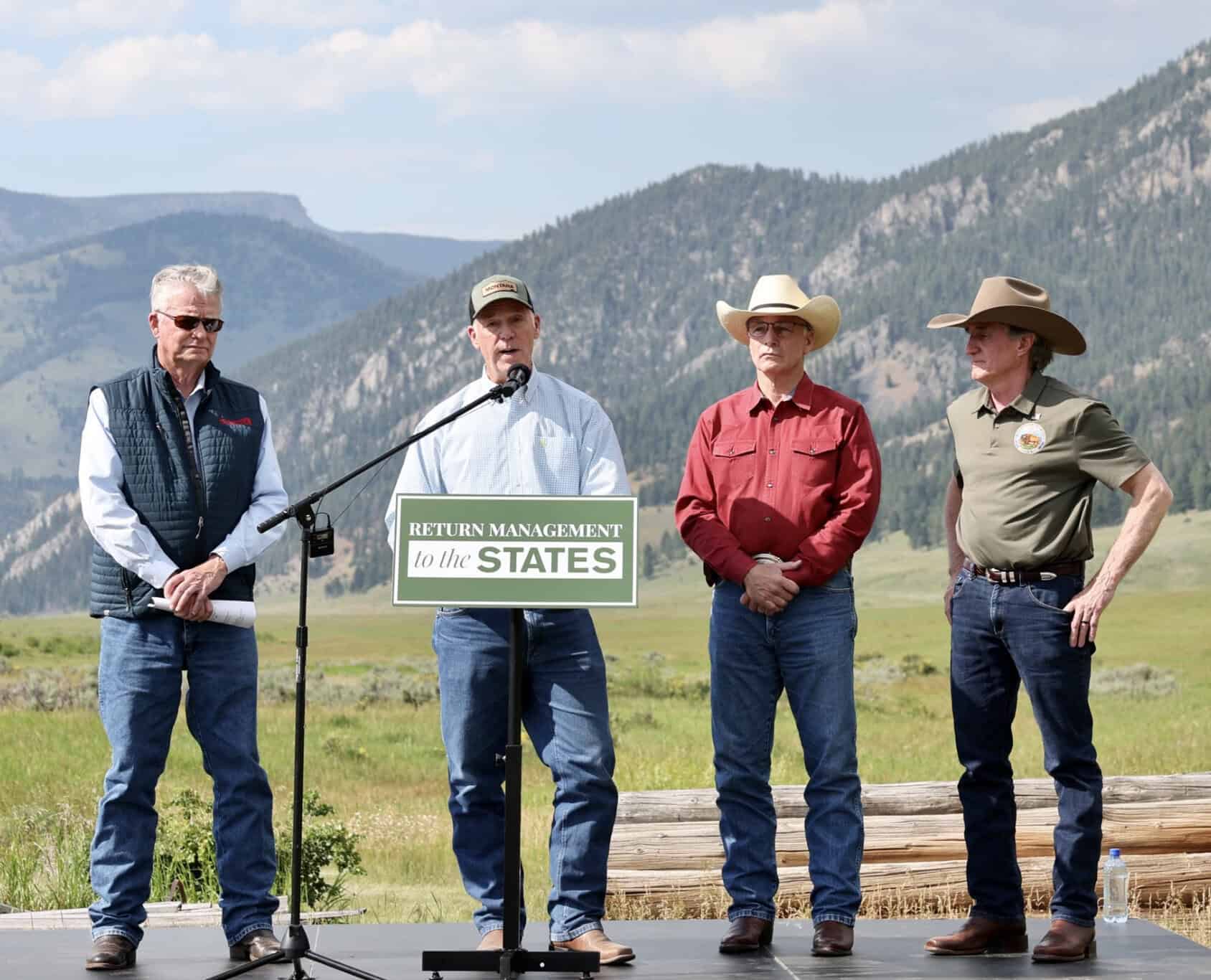
One of our Evergreen directors recently briefed Secretary Burgum and the governors of several western states concerning our grizzly habitat restoration project underway in Lincoln County, Montana.
He was well received, and the press conference was widely reported.
Why so much media attention now?
Because the kind of habitat restoration work we are doing on private and state land is prohibited by provisions of the 1973 Endangered Species Act.
Those who oppose active forest management aim to keep it this way.
Fish and wildlife habitats are regulated by the U.S. Fish and Wildlife Service and the National Marine Fisheries Service. Both agencies are in Burgum’s wheelhouse.
To succeed, we must demonstrate that the thinning and vegetation management work we are doing on state and private land in Lincoln County can be replicated on federal land.
About 200,000 federally owned acres lie within rural neighborhoods included in the federally designated Wildland-Urban Interface.
Currently, we are working on private land in the Bull River Valley south of Troy, Montana, but we will soon move to an adjacent parcel owned by Montana Fish, Wildlife and Parks.
[See the Adaptive Management PDF above.]
Our research partners include Montana Fish, Wildlife and Parks; the U.S. Fish and Wildlife Service; the Montana Department of Natural Resources and Conservation; the Forest Service’s Rocky Mountain Research Station; the Kootenai Stakeholders Coalition; and two Indian tribes.
Rocky Mountain Research Station biologists are using trail cameras to monitor grizzly bear traffic within our project area.
When their work is completed in about four years, they will write a peer-reviewed report that we hope will open the door to similar habitat restoration work on the Kootenai National Forest.
Secretary Burgum and the governors know all of this. The governors hope Secretary Burgum will ultimately transfer grizzly management authority to parallel state agencies.
This is why the Trump administration has proposed an amendment to the prohibitions enumerated in the Endangered Species Act’s 4(d) rule associated with grizzly bear habitat.
Secretary Burgum released his proposed 4(d) amendment on July 17.
Time is short. You have until August 17 to comment.
Visit the U.S. Fish and Wildlife Service grizzly bear rulemaking page to submit your comments.
Opponents of the Trump administration’s proposed 4(d) amendment are already predicting catastrophe.
Their claims:
One Facebook post announced:
“BREAKING. Trump admin plans to shift grizzly bear management to hostile Northern Rockies states.”
Hostile?
The exact opposite is true.
Idaho Governor Brad Little, Montana Governor Greg Gianforte, and Wyoming Governor Mark Gordon are not hostile to grizzly bears.
They are supporting the active habitat management that grizzly bears need.
Here are the facts:
These are not abstract policy arguments.
They concern the health of forests, wildlife habitat, rural communities, and millions of people who are breathing wildfire smoke.
Does conveying these nine messages to an uninformed public in support of the Trump administration, Secretaries Burgum and Rollins, and the governors of the so-called “hostile Northern Rockies states” seem important to you?
It does to us.
Someone has to separate fact from fear and explain what active forest management actually looks like. We believe that is our moral and ethical responsibility.
Your 100% tax-deductible subscription allows us to continue providing science-based forestry information with the goal of ensuring healthy forests forever.