
...but only if we get it right
Our colleague, Frank Carroll, has written a short but compelling endorsement of the what he calls the most significant structural
Our colleague, Frank Carroll, has written a short but compelling endorsement of the what he calls the most significant structural

Editor's Note: This article was first drafted in October 2017 and published in January 2018. Here we are

"Constant procedural tinkering does not, I fear, lead to efficiency or simplicity." Long before the recently announced Forest

I have written several articles that touch on the value of curiosity and the risk of collapsing complex issues into false certainty.
In this article, I want to examine how that collapse shows up, concretely, in forestry decisions, public risk, and the way information itself is handled.
Let’s take the next step together and apply curiosity to forestry communication and stewardship. Let's examine what is lost when attention gives way to ideology, speed, or convenience.
Good forest management does not begin with ideology. It begins with questions.
What is happening here — on this landscape, in this watershed, in this stand of trees?
What does the data show, and what does lived experience confirm or complicate?
What has changed — ecologically, socially, climatically — and what has not?
Curiosity keeps those questions open long enough for understanding to emerge. It resists the urge to rush toward certainty, especially when certainty feels efficient or reassuring.
Forests are adaptive systems. They do not respond well to one-size-fits-all thinking. When curiosity is present, managers, scientists, policymakers, and communities remain open to complexity. They notice nuance. They resist premature certainty.
Good stewardship translates forest science into public understanding, slows the conversation down when it becomes reactive, and insists that clarity takes precedence over noise.
In forestry, curiosity is not optional. It is a professional discipline and the groundwork of stewardship.
When curiosity collapses, something will always fill the space left behind.
In forestry, that replacement is rarely overt. It often appears as efficiency — streamlined narratives, selective data, or conclusions reached too quickly to be fully tested.
When curiosity erodes, the system doesn’t collapse all at once. It thins. And that thinning creates just enough space for other forces to move in - gremlins - quietly, efficiently, and without announcement.
These forces are not dramatic. They are small, opportunistic interferences that appear when attention wanes and systems lose structure.
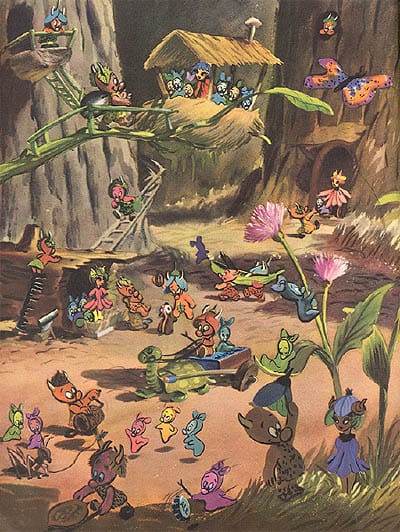
Facade presents a surface that feels complete.
What fits the existing story remains visible, while information that complicates it is absorbed, explained away, or never fully enters the frame. Nothing appears missing. The structure looks sound — until decisions begin to rely on what lies behind it.
Echo repeats the story we want to tell ourself.
Familiar ideas return louder and more frequently, mistaken for balance or confirmation. Repetition begins to stand in for evidence, and agreement feels like validation rather than scrutiny.
Haze reduces contrast and vision.
Differences within groups fade into sameness, and textured, place-based realities blur into indistinct categories. From a distance, everything begins to look alike.
These three gremlins of erosion thrive where attention has thinned and curiosity has eroded. They chip away and character and integrity.
When curiosity is restored, their influence recedes.
Once this narrowing takes hold, the conversation changes.
Questions are treated as obstruction.
Variables that complicate the story are set aside.
Evidence is filtered through what already appears coherent rather than allowed to challenge it.
Over time, uncertainty becomes suspect.
Complex systems place cognitive demands on everyone working within them. Forestry is no exception. When institutional, political, or social pressure rewards clarity over accuracy, curiosity is often the first casualty. What remains may feel decisive — but it is also brittle.
The consequences of a brittle construct surface in unmanaged risk, in policy that oscillates rather than adapts, and in communities left exposed to outcomes they did not help shape.
Forests continue responding to disturbance, fuel accumulation, and climate whether our narratives keep pace or not.
Certainty can feel responsible. It signals control. But in forestry, certainty that arrives before understanding does not protect landscapes or people.
It merely delays reckoning.
Curiosity notices.
Stewardship decides what to do with what has been seen.
Stewardship is not passive. It is not neutrality. It is the responsibility that follows attention.
In forestry, stewardship looks like acting on fire risk before catastrophe, not after.
It means managing forests for resilience rather than aesthetics or ideology.
It requires holding ecological health, community safety, and long-term outcomes in the same frame — even when doing so is uncomfortable.
Stewardship is also temporal. Decisions made today echo decades forward. Forests remember what we do to them. They carry the imprint of our attention — or our neglect — long after we move on.
This long view comes from the practice is curiosity.
It resists short-term narratives.
Protects credibility through Science-based work.
Ensures that stewardship over information matters as much as stewardship on the ground.
One of the quiet challenges in forestry communication is helping people connect dots that are often discussed separately — fire behavior, forest structure, climate, policy, history, and human presence on the land.
Connecting dots requires patience. It requires listening across disciplines and lived experience. It requires humility — the willingness to say, “We don’t know yet,” or “This is more complicated than it sounds.”
That kind of leadership is rarely flashy. It does not trend well on social media and is often dismissed in decision making circles - but it is exactly what stewardship requires.
We need to lead relationally, systemically, with an eye toward long-term care rather than short-term wins. Forestry needs more of that posture at the table.
Not louder voices. More attentive ones.
Forests do not need us to agree with one another. They need us to pay attention.
Our forests need decisions rooted in evidence, experience, and care — not performance or certainty. They need communicators willing to hold complexity without flattening it. They need stewardship that begins with curiosity and follows through with responsibility.
It is time to actively nurture that space — where understanding can grow, where nuance is not treated as weakness, and where stewardship is understood as an ongoing practice, not a talking point.
What we attend to, we tend.
What we tend, we shape.
And what we shape, determines the future.
Like what we are up to?
Support Evergreen!
Evergreen is supported by readers who value independent, science-based forestry reporting.
(Donate or Subscribe)

This is a repost of the second half of Braided Stewardship: Science, Responsibility, and Legacy. In hindsight, if I had

What follows is a two-part article — longer than our usual format — written with the hope that it offers meaningful insight

A century after the conservation idea took root, its renewal lies where it began — in connection, community, and care for one another and the land.

Our mission is public education as it relates to all things forestry. Your support ensures we can provide the quality
Your 100% tax-deductible subscription allows us to continue providing science-based forestry information with the goal of ensuring healthy forests forever.